

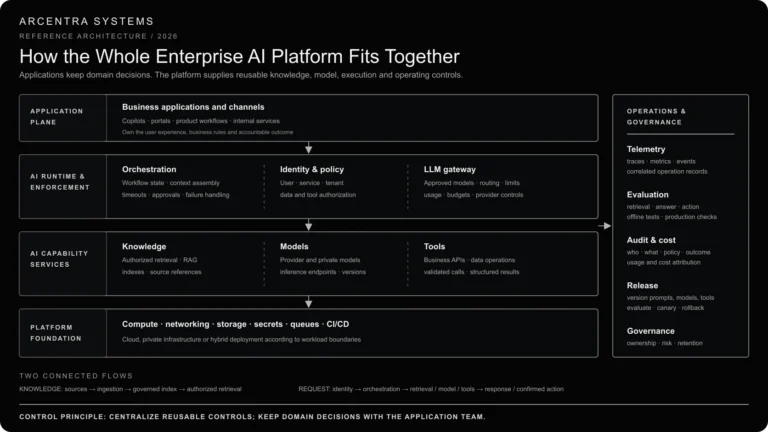
How the Whole Enterprise AI Platform Fits Together
See how applications, identity, RAG, LLM gateways, models, tools, observability and governance fit into one enterprise AI platform.

See how applications, identity, RAG, LLM gateways, models, tools, observability and governance fit into one enterprise AI platform.

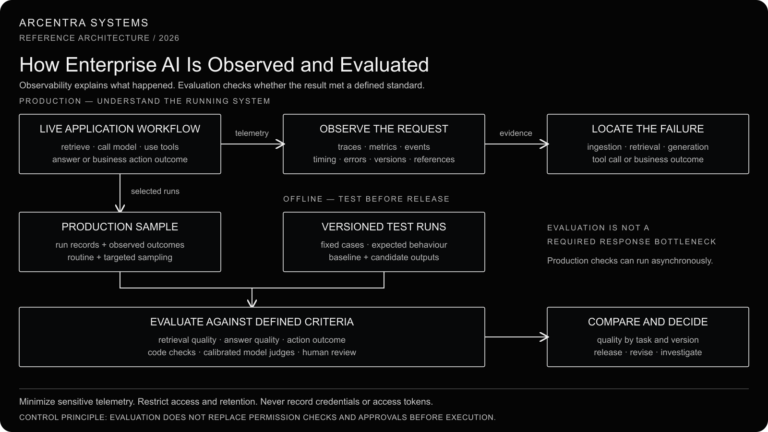
An AI assistant can answer quickly and still be wrong. Learn how traces, retrieval checks, answer evaluation and verified tool outcomes help engineers find the failed step.

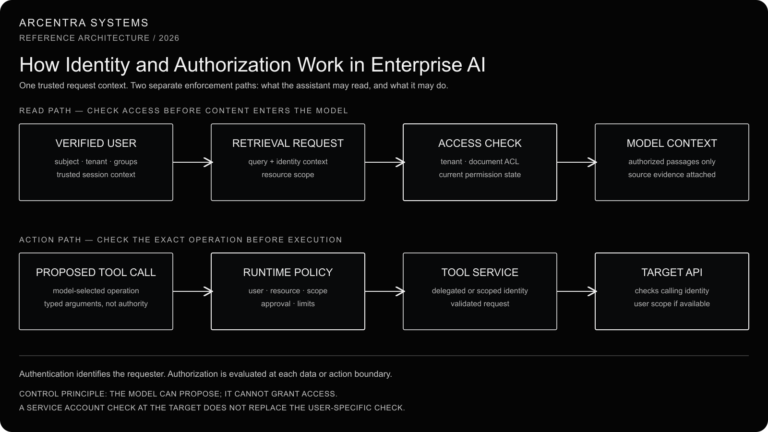
Authentication identifies the requester; authorization controls what an AI assistant may read or do. See how user context, document permissions, tool policy and target APIs work together.

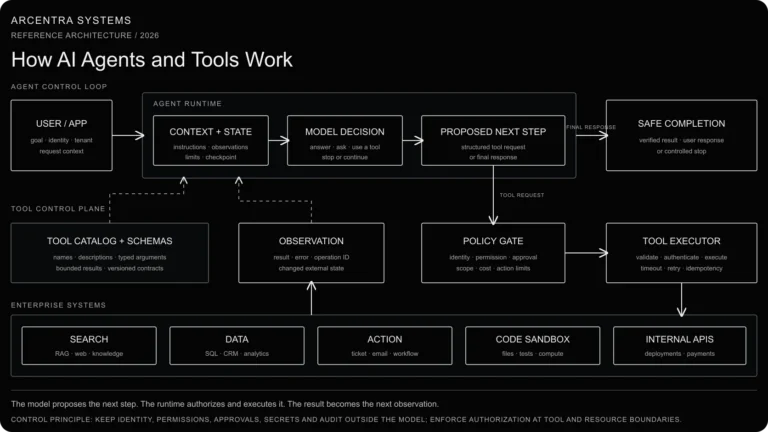
An AI agent is a runtime loop around a language model and approved tools. Follow a task through model decisions, policy checks, execution, observations and safe completion.

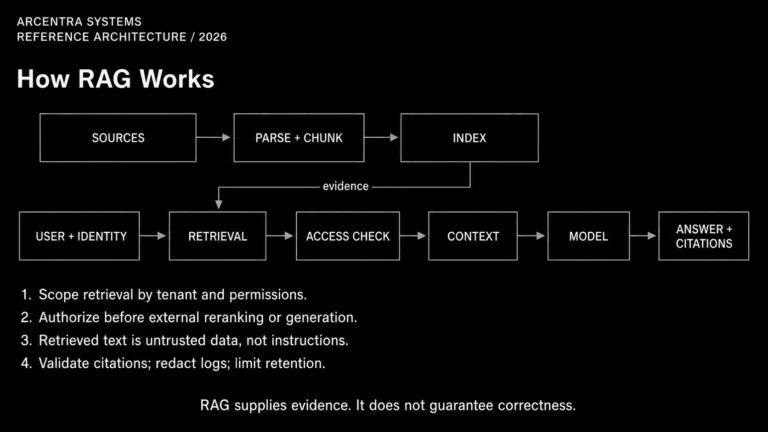
RAG retrieves evidence before a language model answers. Follow an incident question through document preparation, permission checks, retrieval and a response that cites its sources.

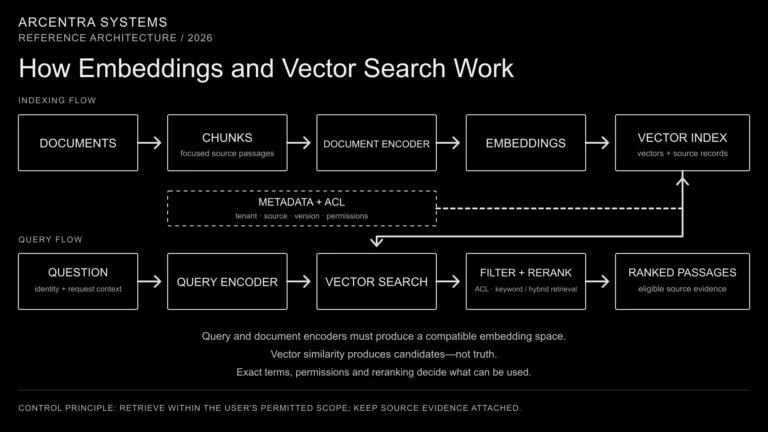
How can a question about leaving a supplier agreement find a clause called termination for convenience? Follow the path from text to embeddings, vector search and ranked source passages.

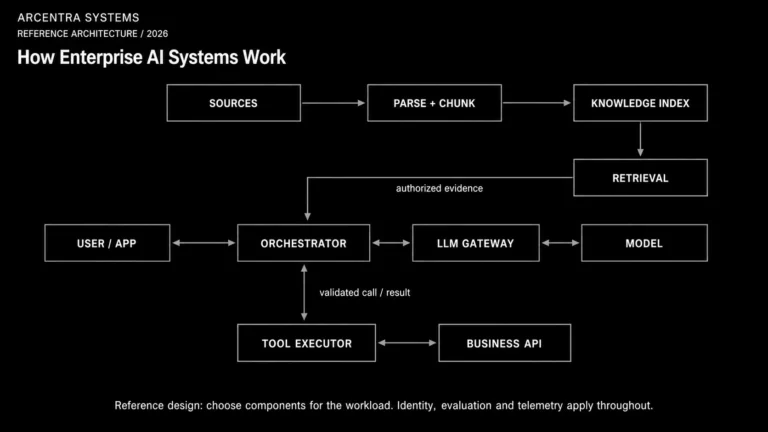
A language model is only one part of an enterprise AI system. Follow a question from the application through company data, access checks and retrieval to an answer or an approved action.

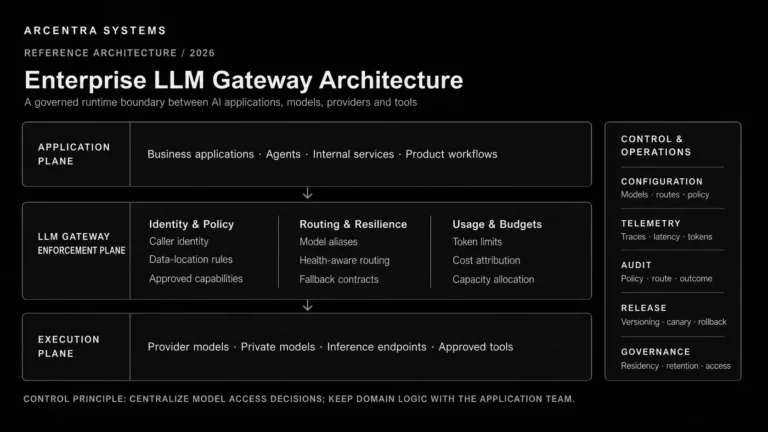
Enterprise AI Systems, Explained — Part 4 The first application rarely needs an LLM gateway. A team can call a model provider directly, keep the API key in a secret store, add a timeout and ship. For one application, that is often the correct architecture. The trouble starts when the same pattern is repeated across […]

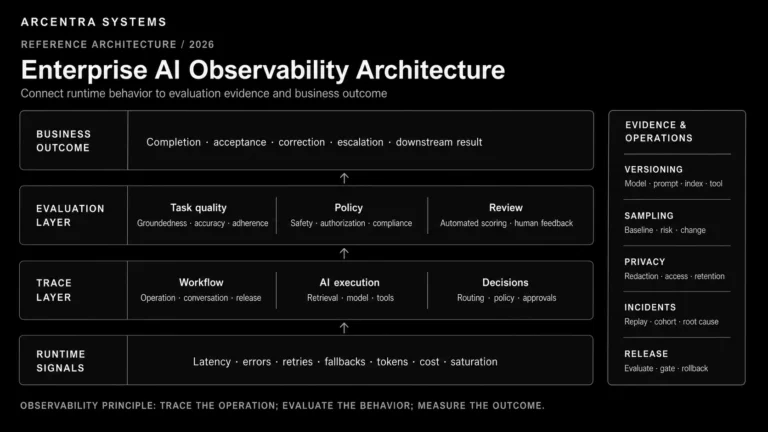
The dashboard is green. The incident is real. The model endpoint is available. P95 latency is inside the objective. Token consumption is stable. HTTP error rate has not moved. Yet users are correcting more answers, an agent is opening the wrong records, and a workflow that used to finish in two tool calls now needs […]

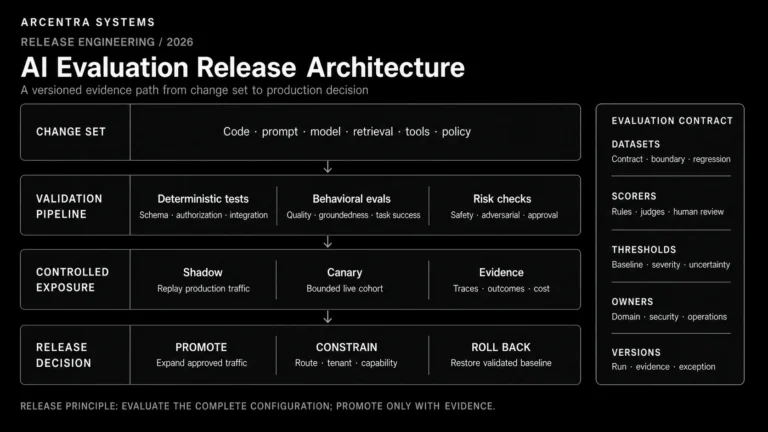
The easiest evaluation to pass is the one that cannot stop a release. Many AI teams have evaluation notebooks, scorecards and dashboards. Far fewer have an explicit answer to a harder question: what evidence is required before a new model, prompt, retrieval index or tool definition is allowed to receive production traffic? Without that decision […]

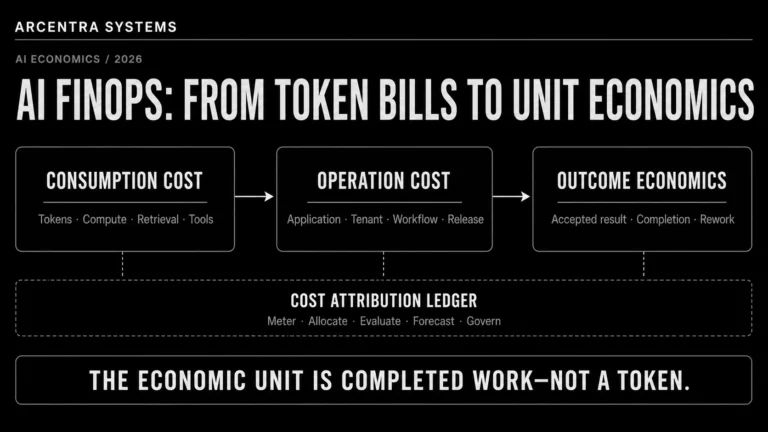
The provider invoice is accurate and still does not tell you what the AI system costs. It can report input tokens, output tokens, provisioned throughput and vector-search usage. It cannot tell you whether a customer case was resolved, whether an agent completed the intended workflow or whether a cheaper model merely moved cost into retries […]