The first application rarely needs an LLM gateway.
A team can call a model provider directly, keep the API key in a secret store, add a timeout and ship. For one application, that is often the correct architecture. The trouble starts when the same pattern is repeated across a portfolio.
One application retries every 429 response. Another fails immediately. One sends prompts to a provider in a different region. Another records complete request bodies in its logs. A third has no way to attribute token spend to a tenant or workflow. Each integration works in isolation, but the enterprise has no common answer to a basic set of operational questions:
- Which application is making the request?
- Which models is it allowed to use?
- Where may the data be processed?
- What happens when the preferred model is unavailable?
- Who owns the budget?
- What evidence remains after the response is returned?
At that point, the problem is no longer model connectivity. It is control.
What is an enterprise LLM gateway?
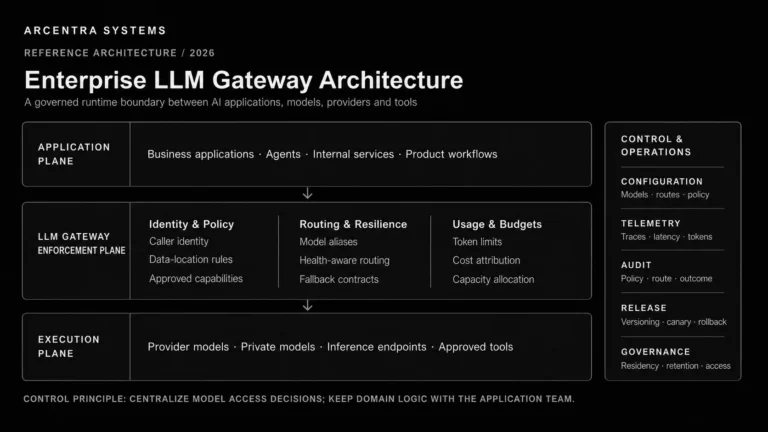
An enterprise LLM gateway is a governed runtime boundary between AI applications and the models, inference endpoints and tools they use. Applications authenticate to the gateway and invoke a stable platform contract. The gateway evaluates policy, selects an approved backend, manages provider credentials, applies traffic controls and emits a consistent operational record.
That definition is deliberately narrower than “AI platform.” A gateway does not own the full lifecycle of enterprise knowledge, agent memory, evaluation datasets or business workflows. It sits in the request path and enforces the decisions that must be consistent across them.
The distinction matters. A proxy forwards traffic. A control plane determines the conditions under which traffic is permitted, where it goes and how the result is accounted for.
Why the gateway becomes a control plane
Traditional API gateways already provide authentication, quotas, routing and telemetry. LLM traffic adds a different set of constraints to the same architectural boundary.
A request has a monetary cost that is not known precisely until the response completes. Capacity is frequently expressed in tokens per minute rather than requests per second. Backends that expose similar APIs are not behaviorally interchangeable. Streaming changes timeout and retry behavior. Prompts and responses can contain sensitive business data. A fallback model may return valid JSON and still change the meaning of a business decision.
Current cloud implementations reflect this shift. Microsoft documents token limits, backend load balancing, circuit breakers, content controls and telemetry as AI gateway capabilities. AWS publishes a multi-provider gateway architecture that centralizes credentials, routing, guardrails, usage tracking and model access behind a unified interface. These are not merely SDK conveniences. They are shared operating controls.
The enterprise LLM gateway becomes the AI control plane when applications stop owning those controls individually.
The six decisions made on every request
1. Establish the caller
The gateway should know more than an API key. It needs an application identity, environment, tenant or business unit, and—where the use case requires it—the delegated identity of the user or agent initiating the request.
This identity becomes the basis for policy, quota and audit. Without it, rate limits collapse into one shared bucket and cost allocation becomes an exercise in inference.
2. Resolve the permitted capability
Applications should request a capability or a platform model alias, not an arbitrary provider model identifier. A contract such as reasoning-standard, document-extraction or low-latency-chat gives the platform room to change providers without forcing every application to understand the provider estate.
The alias must be versioned. Silently replacing the model behind a stable name is operationally convenient and behaviorally dangerous. Applications need to know whether a change is a capacity adjustment, an approved compatible revision or a new release requiring evaluation.
3. Evaluate policy
Policy answers whether this caller may use this capability with this class of data in this region. It may also decide whether input or output inspection is required, whether a request can leave a private network, and whether a human approval state must be present.
Policy should operate on explicit metadata. Asking the gateway to guess data sensitivity from the prompt is not a substitute for classification at the source. Content inspection can be a defense layer, but it should not become the primary authorization mechanism.
4. Select a backend
Routing is where many gateway designs become too clever. The safest production policy is usually deterministic: filter to approved backends, remove unhealthy or exhausted targets, then select according to a declared strategy.
Useful inputs include region, model capability, context length, reserved capacity, latency, recent error rate and unit cost. Semantic request classification can be added later, but it creates another model-dependent decision that must itself be observed and evaluated.
5. Enforce consumption limits
Request limits are insufficient for LLM workloads. Ten small classification calls and ten long-context generations are not equivalent. The gateway needs token-rate limits, budget scopes and usage attribution tied to the caller.
There is an unavoidable timing problem: final output-token usage is available only after generation. Pre-request estimation can reject obviously oversized prompts, while post-response accounting updates the actual budget. Under concurrency, a tenant may temporarily exceed a nominal limit. The system should document that behavior rather than pretend the counter is exact.
6. Produce evidence
Every request should leave a trace that can be joined to the application workflow. At minimum, operators need the caller, route, requested and resolved model, policy decision, latency, token usage, retry or fallback history, outcome and cost attribution key.
Prompt and response bodies require a separate retention decision. Recording everything creates a useful debugging archive and a serious data-governance problem. In many environments, metadata is retained by default while content capture is sampled, redacted or disabled for sensitive routes.
OpenTelemetry defines generative-AI attributes for operations, providers, requested and returned models, token usage, agents, tools and retrieval. Using a common telemetry vocabulary makes the gateway observable through the same systems that already operate the rest of the platform.
The gateway contract should be smaller than the provider APIs
A common mistake is to promise complete provider portability. Teams expose every parameter supported by every backend through one “unified” API. The result is a contract that is both lowest-common-denominator and permanently coupled to provider-specific extensions.
A stable enterprise contract should cover the semantics the organization is prepared to support: messages or input, a declared capability, structured output requirements, streaming behavior, tool definitions, request metadata and trace context. Provider-specific controls can exist behind an explicit escape hatch, but they should not leak into every application by default.
Portability is not achieved because two providers accept similar JSON. It is achieved when the organization defines which behaviors are contractual, tests them and controls changes.
Failover is a product decision, not only a routing decision
HTTP infrastructure encourages a simple mental model: if one backend fails, retry another. That is safe only when the backends are genuinely interchangeable for the task.
Models differ in instruction following, tool selection, refusal behavior, context handling and structured-output reliability. A fallback can preserve availability while degrading the business process in a way that does not produce an obvious infrastructure error.
Each route therefore needs an explicit failure contract:
- Which errors are retryable?
- Can a partially streamed response be retried?
- Is the operation idempotent?
- Which fallback models have passed the same evaluation suite?
- Should the application receive a degraded-mode signal?
- When must the system fail closed?
For a low-risk summarization workflow, a fallback model may be acceptable. For a regulated decision or an agent preparing a financial transaction, returning an explicit unavailable state may be the safer behavior.
What belongs in the gateway—and what does not
The gateway should own controls that are cross-cutting, enforceable in the request path and consistent across applications:
- caller authentication and application identity;
- provider credential brokering;
- model aliases and approved backend inventories;
- policy enforcement and regional constraints;
- rate limits, token quotas and budget attribution;
- timeouts, circuit breakers and controlled failover;
- standard telemetry, audit metadata and redaction hooks.
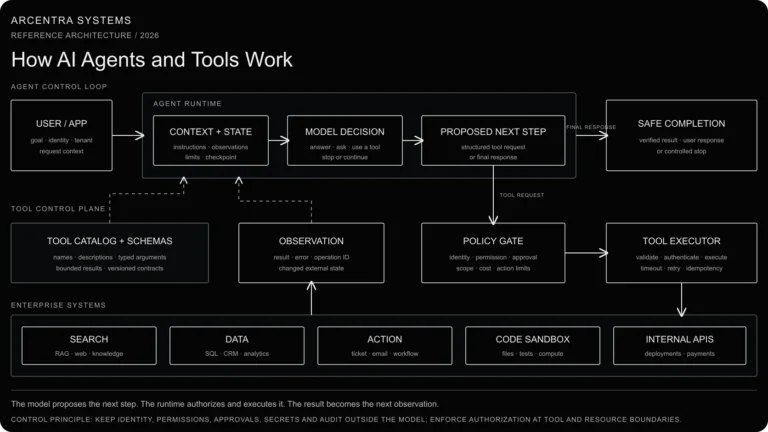
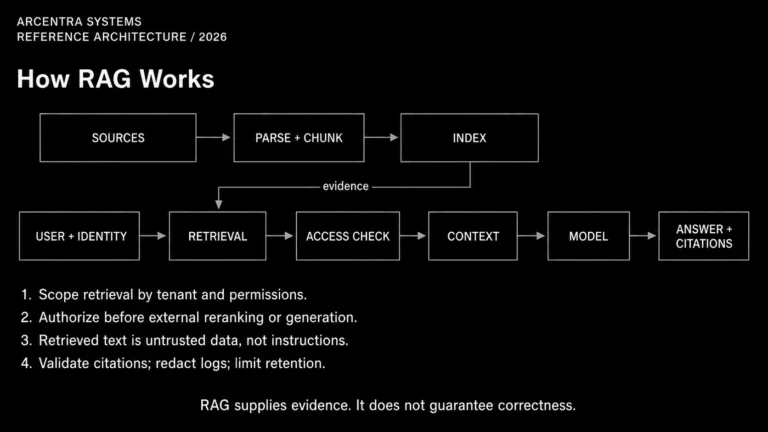
It should not become the place where every AI concern is centralized. Domain prompts, retrieval logic, business approvals, agent memory and workflow state belong closer to the applications and services that understand their semantics. Evaluation policy may be managed at platform level, but evaluation execution belongs in the delivery lifecycle rather than the synchronous request path.
A gateway that absorbs domain behavior becomes a distributed monolith with a particularly expensive hot path.
Control plane and data plane must be separated
The runtime gateway is the data plane. It processes requests under an already approved configuration. The management services around it form the control plane: model registry, route definitions, policy bundles, credential references, quota assignments and release history.
Separating them provides two operational advantages.
First, a control-plane outage does not need to stop inference. Gateway instances can continue operating from the last valid signed configuration. Second, configuration changes become deployable artifacts. A routing rule can be reviewed, tested, canaried and rolled back instead of being edited directly in a production console.
This is also the boundary at which enterprise governance becomes executable. A policy document may state that sensitive workloads must remain in an approved region. The control plane translates that requirement into an allowed backend set; the data plane enforces it on every request.
Operating the gateway as production infrastructure
The gateway sits on the critical path of every AI-enabled application. Its availability target should be higher than the target of any single model backend, and its failure modes should be intentionally boring.
That requires:
- stateless or carefully partitioned runtime instances;
- bounded retries with jitter and retry budgets;
- circuit breakers based on provider response semantics;
- load tests that include streaming and long-context requests;
- configuration validation before rollout;
- cardinality controls for telemetry labels;
- content logging disabled or redacted by default;
- capacity and quota dashboards by application, tenant and backend.
It also needs end-to-end traces. Gateway latency alone cannot explain a slow agent. Operators must correlate the model call with retrieval, tool execution and the business workflow around it. This is why an LLM gateway complements, rather than replaces, the broader production AI observability described in our production AI operations model.
A practical adoption sequence
Building the full control plane before the first use case is usually unnecessary. A safer sequence follows the controls that become shared first.
Stage 1: Establish the boundary
Move provider credentials out of applications. Introduce application identities, a stable endpoint, basic quotas and uniform request telemetry. Preserve simple deterministic routing.
Stage 2: Make routing and policy explicit
Add versioned model aliases, approved backend inventories, regional constraints, circuit breakers and tested fallback classes. Attribute usage to applications and business owners.
Stage 3: Operate it as a platform contract
Manage configuration through code and release gates. Connect route changes to evaluation evidence. Add self-service onboarding, budget delegation and policy packs for different workload classes.
The inflection point is the same one that turns isolated AI integrations into enterprise AI infrastructure: multiple applications require the same controls, and duplicating those controls is now riskier than operating them centrally.
Build, buy or extend an API gateway?
The answer depends less on feature count than on the operating environment.
Extending an existing API management layer can work when the organization already has strong identity, networking, policy and telemetry practices there. A purpose-built LLM gateway can accelerate multi-provider routing and token accounting. A managed cloud gateway can reduce operational burden when the model estate is concentrated in one platform.
None of these choices removes the architectural work. The organization still has to define its model contract, identity model, failure semantics, evidence requirements and ownership boundaries. Buying a gateway product before defining those decisions merely moves ambiguity into configuration.
The most durable design keeps applications dependent on an enterprise contract, not on the internal implementation of the gateway. That preserves the option to replace the runtime without rebuilding every AI application.
The control plane is the product
An enterprise LLM gateway is useful because it centralizes traffic. It becomes strategic when it centralizes decisions.
The durable asset is not the proxy process or the provider adapter. It is the governed contract around model access: who may call, what they may request, where execution may occur, how failures are handled, how consumption is attributed and what evidence is retained.
That contract is what allows an enterprise to change models without surrendering operational control. It is also what separates a portfolio of AI integrations from an AI platform that can be operated.