The provider invoice is accurate and still does not tell you what the AI system costs.
It can report input tokens, output tokens, provisioned throughput and vector-search usage. It cannot tell you whether a customer case was resolved, whether an agent completed the intended workflow or whether a cheaper model merely moved cost into retries and human correction.
This is where many enterprise AI cost programs stop too early. They optimize the price of inference while leaving the economics of the operation undefined.
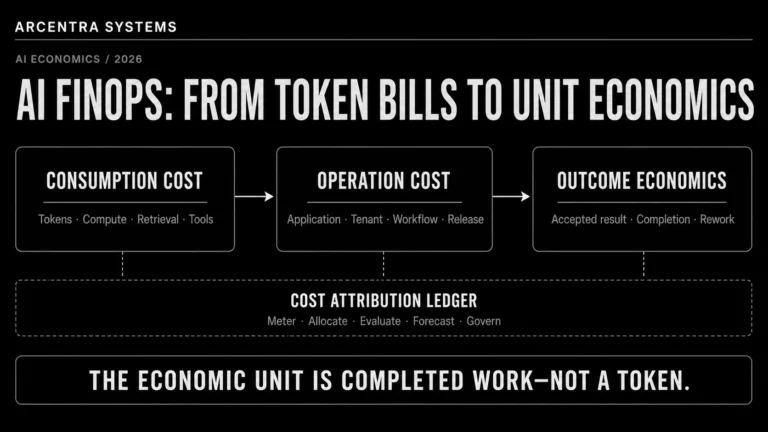
AI FinOps becomes useful when cost is attributed to a versioned workload and divided by a defensible unit of completed work. The important number is not cost per token. It is cost per accepted extraction, resolved case, approved decision or completed workflow—measured together with quality, latency and risk.
What is AI FinOps?
AI FinOps is the operating discipline that connects AI consumption, architecture decisions and business outcomes so engineering, finance and product teams can control the economics of production AI systems.
It has four responsibilities:
- meter the resources consumed by each AI operation;
- attribute direct and shared cost to the responsible workload;
- calculate unit economics using completed business outcomes;
- enforce budgets and optimization policies without silently degrading the service contract.
The FinOps Foundation now treats AI as a distinct technology category because its cost is granular, volatile and distributed across providers, cloud infrastructure, SaaS products and private capacity. Its guidance also makes unit economics central: cost per token is only an early technical metric; mature programs connect that consumption to units such as an assist, an agent action or a case resolved.
That distinction matters. Tokens describe how a model was used. Unit economics describe whether the use was worthwhile.
A provider bill is not a workload cost model
A generative AI operation can consume resources across several systems:
- model inference, including cached, input, output and reasoning tokens;
- embeddings, reranking, vector queries and knowledge storage;
- API gateway, policy and guardrail execution;
- agent tools, external APIs and transactional systems;
- compute, queues, databases, observability and network transfer;
- evaluation models and human review;
- retries, fallbacks, abandoned runs and compensating actions.
The model line item may be the largest variable component, but it is not automatically the full cost. A workflow can reduce token spend while increasing search calls, tool execution or manual handling. Another can use an expensive model yet complete the task in one attempt and produce lower total cost.
Cost therefore belongs to the complete operation trace, not to an isolated model request. This is the same architectural boundary used for reliability: the system must preserve one operation identity across application, gateway, retrieval, model, tools and outcome. The operating requirements are described in our guide to production AI operations and reliability.
Use three levels of cost measurement
1. Consumption cost
This is the mechanically measured layer: tokens, requests, model time, GPU time, search operations, storage, network and external-service charges.
Consumption cost is required for reconciliation and technical optimization. It can identify an increase in output length, a drop in cache hits or a route that moved to a more expensive model. It cannot determine whether the operation created useful work.
2. Operation cost
Operation cost aggregates every resource used by one end-to-end workflow. A support operation may contain classification, retrieval, two model calls, a CRM query, policy checks and an escalation. The relevant cost is their sum, including failed attempts.
Useful operation units include:
- cost per document processed;
- cost per agent run;
- cost per support conversation;
- cost per research report generated;
- cost per compliance review attempted.
This level allows engineers to compare architectures. It can show that a narrow retrieval filter lowered both context size and latency, or that a new tool introduced repeated loops which made an apparently cheap model route more expensive.
3. Outcome cost
Outcome cost uses successful work as the denominator:
Cost per successful outcome = total attributable cost / accepted outcomes.
The definition of accepted must come from the business process. It might mean a case resolved without reopening, a field extraction accepted without correction, an approved code change or a completed transaction that was not reversed.
This exposes false savings. If a model change lowers operation cost by 20 percent but increases rework and reduces acceptance, the cost per accepted outcome can rise. The optimization saved computation and damaged the economics.
The FinOps Foundation describes the same progression in its unit economics capability: resource-efficiency measures such as cost per token need to connect to business measures such as cost per transaction, tenant or case resolved.
Every operation needs a cost attribution envelope
Allocation cannot be reconstructed reliably from a monthly invoice. The necessary dimensions must travel with the request while it executes.
A practical cost attribution envelope contains:
- operation and trace identifiers;
- application, product and owning team;
- tenant, customer or internal cost center;
- workflow and capability;
- environment and region;
- release, prompt, model route and policy versions;
- requested and resolved provider model;
- budget class and service tier;
- final outcome and acceptance state.
The envelope should be attached at the platform entry point and propagated to retrieval, inference, tool and telemetry records. Provider billing data can then be reconciled with the near-real-time operational ledger.
Microsoft’s architecture guidance identifies the same requirement for chargeback: native model telemetry often cannot associate usage with an application or business unit, so a gateway or equivalent shared control must add client identity and attribution context. This is one reason the enterprise AI platform needs a common access contract rather than independent provider integration in every application.
Shared platform cost needs an explicit allocation policy
Not every cost belongs directly to one request. Gateways, evaluation services, vector clusters, observability pipelines, reserved capacity and platform teams are shared.
There are three defensible treatments:
- Direct allocation: assign metered consumption to the workload that generated it.
- Shared allocation: distribute common cost using a declared driver such as requests, tokens, compute time, stored vectors or active tenants.
- Platform investment: retain genuinely common capability as a central cost rather than inventing false precision.
The allocation rule must be versioned and visible. Changing the denominator can make a team’s apparent efficiency improve without changing the system.
Showback is usually the correct first control. It gives teams visibility without creating immediate incentives to manipulate attribution or avoid shared controls. Chargeback should follow only when the data is stable, disputed costs can be explained and teams have meaningful levers to change their consumption.
Budgets must operate on workloads, not provider accounts
A monthly provider budget is necessary but late. It reports that money has been consumed after the architecture has already made the decision.
Production controls need budgets at several time horizons:
- per request: maximum input, output and tool-call cost;
- per operation: maximum steps, retries and total execution cost;
- per tenant or product: daily and monthly consumption limits;
- per release: expected unit-cost range and allowed regression;
- per portfolio: forecast, commitments and capacity exposure.
The request-path controls belong at the gateway and orchestration layer. They can reject an oversized context, cap output, restrict agent loops, route to a different model or require approval for an expensive workflow. Microsoft recommends gateway-level quotas, token caps, routing policies and chargeback dimensions for shared AI workloads. AWS similarly recommends token budgets, tiered routing, scoped retrieval and caching as production cost controls.
A budget must still respect the task contract. Quietly switching a regulated extraction route to a weaker model is not cost control; it is an undocumented product change.
Optimize the complete cost path
Route by required capability
Sending every request to the strongest available model wastes both money and latency. Define task classes and route each one to the least expensive model configuration that can satisfy its evaluation contract. Escalate only when confidence, complexity or policy requires it.
Routing must be evaluated on outcome cost. A smaller model that triggers more retries, tool errors or human corrections can be more expensive than the primary route.
Control context before it reaches the model
Long context is often an architecture symptom. Measure system prompts, conversation history, retrieved evidence and tool descriptions separately. Give each component an explicit budget.
Retrieval should reduce uncertainty, not fill the context window. Metadata filtering, permission-aware candidate selection and reranking can reduce irrelevant context while improving grounding. The security constraints remain primary: cheaper retrieval is not useful if it leaks unauthorized data.
Cache stable computation
Prompt caching, deterministic result caching and tool-result caching can remove repeated work. AWS’s Generative AI Lens recommends prompt caching to reduce input-token cost and latency where providers support it.
Caching requires identity, version and freshness boundaries. A semantically similar answer cannot be reused across tenants merely because the prompts look alike. Include model, prompt, policy, knowledge and authorization scope in the cache decision.
Control retries and fallbacks
Retries can hide reliability problems while multiplying spend. Record the original failure, every additional model or tool call and the final outcome. Separate provider recovery from semantic retry: they have different causes and different controls.
A fallback route should have a cost and quality contract. If it is invoked continuously, it is no longer a resilience mechanism; it is the production architecture and should be budgeted accordingly.
Choose capacity from workload shape
Pay-per-token, provisioned throughput and self-hosted inference have different economic curves. The correct choice depends on sustained utilization, burstiness, latency objectives, model lifecycle, regional constraints and operational capability.
Do not compare a provider token price with a GPU hourly rate. Compare fully loaded cost at the required goodput: accepted outcomes delivered inside the latency and quality contract.
Forecast demand from operations, not token growth
A forecast that says token usage will grow by 30 percent contains no workload explanation.
Build the forecast from business demand:
- expected operations by workflow and tenant;
- input shape and expected execution path;
- model, retrieval and tool consumption per operation;
- retry, fallback and acceptance rates;
- shared platform and committed-capacity allocation;
- cost per attempted and successful outcome.
This model separates volume growth from efficiency regression. If total spend rises because successful transactions doubled, the system may be improving. If spend rises while accepted outcomes remain flat, the trace can identify whether the cause is larger context, a routing change, lower cache reuse or degraded completion.
The forecast must be recalibrated with production cohorts after every material model, prompt, retrieval or tool release.
Cost is a release dimension
AI cost should be evaluated before deployment, not discovered in the next invoice.
Every release candidate should run against a representative workload and report:
- cost distribution per operation;
- cost per accepted result;
- token, retrieval and tool-call composition;
- retry and fallback cost;
- latency and quality relative to the deployed baseline;
- projected impact at production volume.
Cost cannot be optimized independently of evaluation. A cheaper release that fails more cases is not cheaper. A more expensive release may be justified if it materially increases completion, reduces manual work or lowers risk.
This makes unit economics part of release engineering. Cost regression should be reviewed alongside quality, safety and latency, using the same immutable configuration and production release identity.
A practical AI FinOps maturity model
Stage 1: Reconcile the bill
Track provider, model, environment and total consumption. Establish invoice reconciliation and basic anomaly alerts. This controls accounting but provides little architectural insight.
Stage 2: Allocate to workloads
Propagate application, tenant, workflow and operation identity. Join model, retrieval, tool and infrastructure cost. Introduce showback and assign an owner to unattributed spend.
Stage 3: Measure unit economics
Define attempted and successful units for each production workflow. Connect traces to authoritative business outcomes. Report cost per accepted outcome with quality and latency.
Stage 4: Enforce runtime policy
Apply budgets, quotas, context limits, routing and loop controls through the shared platform. Treat overrides as auditable risk and product decisions.
Stage 5: Govern economics through releases
Forecast from workload demand, evaluate cost before promotion and compare production cohorts after deployment. Use unit economics to drive architecture, capacity, pricing and portfolio decisions.
The economic unit is completed work
Token prices matter. They influence routing, provider selection and capacity planning. But a token has no business value by itself.
The enterprise needs to know which workload consumed it, which release caused the demand, what other systems participated and whether the operation produced an accepted result.
That is the dividing line between AI cost reporting and AI FinOps.
Cost reporting explains where the invoice came from. AI FinOps makes the architecture economically governable: every operation is attributable, every optimization is evaluated against quality, and every unit of spend can be related to useful work.
Sources and further reading
- FinOps Foundation: FinOps for AI
- FinOps Foundation: Unit Economics
- FinOps Foundation: FinOps for AI—Tools and Services Considerations
- AWS: Architecting generative AI applications for production
- AWS Generative AI Lens: Implement prompt caching to reduce token costs
- Microsoft Azure Well-Architected Framework: Application design for AI workloads
- Microsoft: Advanced monitoring for Foundry Models through a gateway