A successful deployment proves that an AI system can run under one configuration, with one set of dependencies, at one point in time. It does not prove that the system can be supported through provider throttling, prompt releases, stale retrieval indexes, tool failures, cost spikes or partial business transactions.
That distinction is the boundary between an AI project and a production service.
Production AI is not operationally ready because a model endpoint is available or a demonstration succeeded. It is ready when an on-call team can detect a failure, reconstruct what happened, limit the impact, restore a known-good state and explain the business outcome without waiting for the original developers.
The question is no longer only, “Can we deploy it?”
It is, “Can we operate it safely while every important component continues to change?”
What Are Production AI Operations?
Production AI operations are the engineering practices, controls and ownership model used to keep an AI-enabled business service observable, recoverable and maintainable after deployment.
The scope is wider than model monitoring. It covers the complete execution path: application code, prompts, models, retrieval, tools, identity, policy, routing, infrastructure, cost and the downstream business state created by the workflow.
This matters because many AI failures do not look like outages. An endpoint can return HTTP 200 while the response uses an obsolete document. An agent can produce a fluent summary after a required tool silently failed. A fallback model can restore availability while violating an output contract. A workflow can time out after completing an irreversible action.
Operations therefore needs evidence about two different realities:
- technical execution: which components ran, with which configuration, latency, errors and dependencies;
- business execution: what the user received, which action was completed and whether the resulting state is correct.
If the first is visible but the second is unknown, the incident is not understood.
Deployment Is a Moment; Operability Is a Continuous System
AI systems continue to change after launch. Providers revise models and rate limits. Prompts and tool schemas evolve. Retrieval content is added, removed and re-indexed. Security policy changes. Teams connect new applications to shared services. A release that improves answer quality may also increase latency, alter refusal behaviour or double the cost of a high-volume workflow.
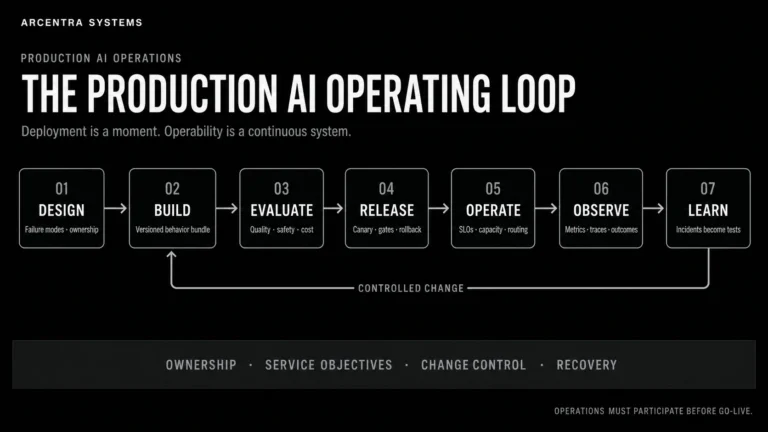
Production does not replace development. It creates a controlled loop between design, engineering, evaluation, release, operations and learning.
Operations must participate before go-live because observability and recovery cannot be added reliably after the first serious incident. The design phase should already establish:
- the service owner and escalation path;
- the intended business outcome and failure boundary;
- the signals required to detect technical and behavioural degradation;
- the configuration that must be versioned together;
- the actions that can be retried, reversed, compensated or stopped;
- the evidence that must be retained for diagnosis and audit.
This is an architectural requirement, not a documentation exercise. If a workflow cannot expose its release identity or final business state, an incident playbook cannot manufacture that information later.
The Operational Contract: Detect, Reconstruct, Contain, Recover and Learn
A supportable production AI service should make five capabilities explicit.
Detect
The system must reveal degradation before it becomes a stream of user complaints. Detection spans infrastructure health, model and workflow behaviour, and business outcomes. Each signal needs an owner, a threshold and a response—not merely a place on a dashboard.
Reconstruct
Operators must be able to follow one request through identity checks, retrieval, model calls, tool execution, retries and downstream actions. The trace must identify the complete release configuration and the resulting business state.
Contain
The operating policy must define how to limit damage: stop the workflow, remove a capability, route to an approved alternative, require human review or continue in a degraded read-only mode.
Recover
The team needs a tested path to restore service. Recovery may require rolling back the complete AI release, replaying an idempotent operation, executing a compensating transaction or reconciling a partially completed business process.
Learn
Every meaningful incident should change the system. The failed request becomes a regression case; missing telemetry becomes an instrumentation requirement; an unsafe retry becomes a new policy or transaction control.
This operational contract is more useful than a generic promise of “high availability” because it describes what the service must enable when the unexpected occurs.
AI Incident Management Depends on Reconstructability
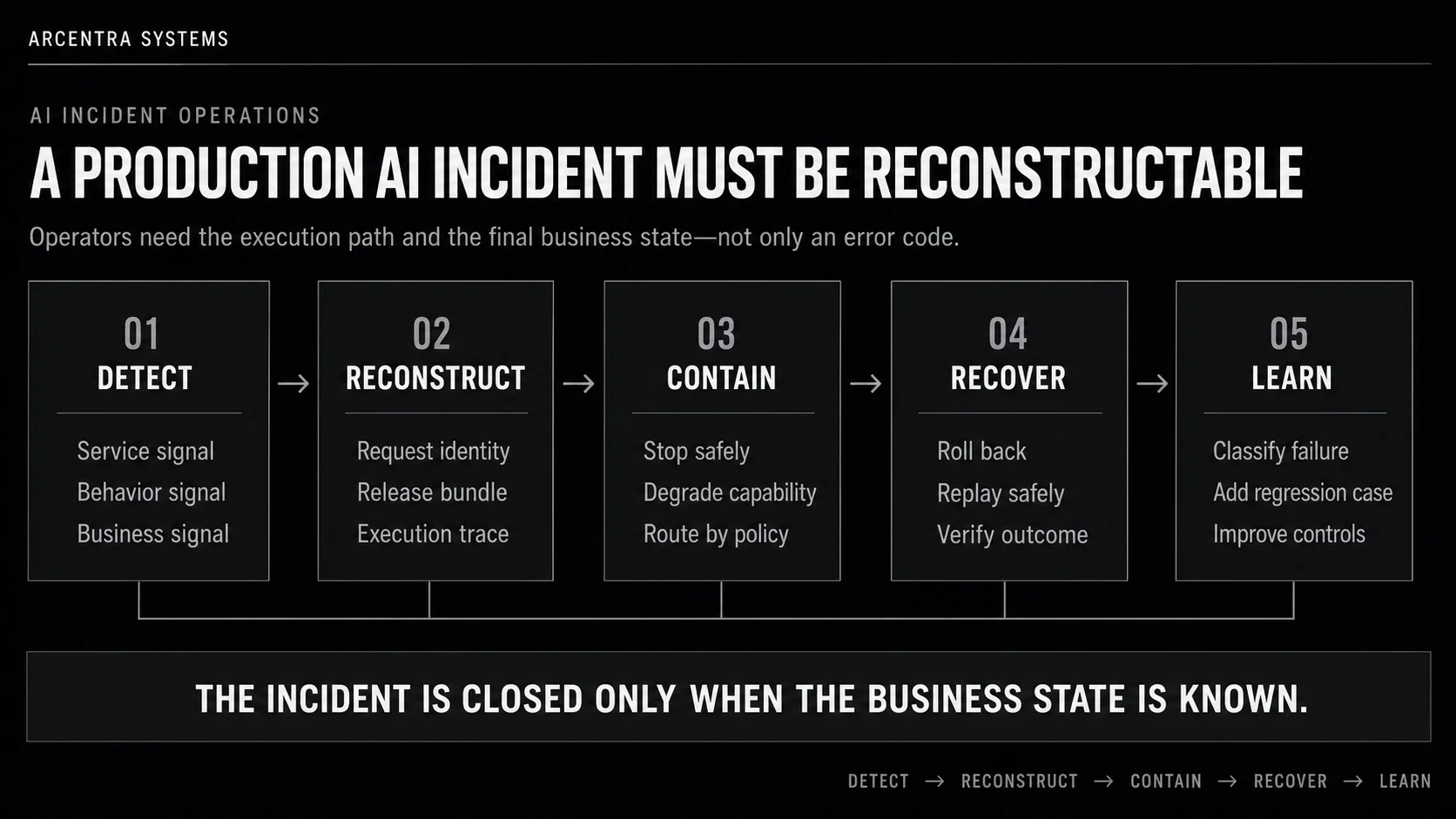
A conventional error code rarely explains an AI incident. The visible response is the product of a chain of changing components, and a technically successful call can still produce an operational failure.
For each affected request, the on-call team should be able to answer:
- Which user, service or event initiated the workflow?
- Which application and business operation were affected?
- Which model, prompt, retrieval index, routing policy and tool definitions were active?
- Which sources and downstream dependencies participated?
- Which retries, fallbacks or loops occurred?
- What did the user receive?
- Which business actions completed, failed or remain uncertain?
- Can the workflow be retried safely, or does it require reconciliation?
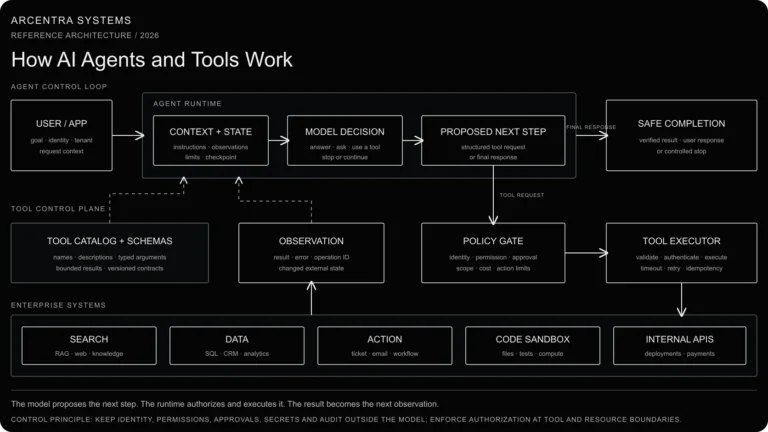
That last question is essential for agents. Rolling back code does not reverse an email already sent, a case already closed or a payment instruction already submitted. Recovery must address side effects, not only software state.
If developers must manually compare raw prompts across multiple systems before Operations can understand an incident, the service has not actually been handed over. It remains a development system with an on-call audience.
Production AI Monitoring Needs Three SLO Planes
Traditional service metrics remain necessary. They are simply not sufficient.
A practical monitoring model uses three related planes:
- Service plane: availability, latency, error rate, saturation, rate limits and dependency failures.
- Behaviour plane: grounding, refusals, invalid tool choices, loop depth, escalation, policy violations and evaluation scores.
- Business plane: completed workflows, manual corrections, abandoned tasks, incorrect actions and cost per successful outcome.
The three planes prevent a common mistake: equating a healthy endpoint with a healthy service.
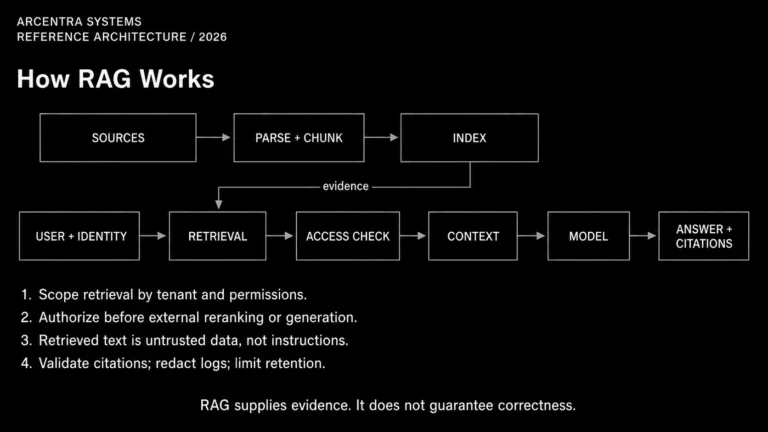
For a retrieval assistant, low latency is irrelevant if the approved knowledge index has not refreshed. For an agent, a completed model call is not success if the intended action never reached the system of record. For a high-volume workflow, acceptable quality can still be commercially unsustainable if retries or context growth push cost per completed task outside its boundary.
Service-level objectives should therefore express both response and outcome. Depending on the use case, an SLO may combine:
- the percentage of requests completed within a latency target;
- the percentage grounded in approved, current sources;
- the percentage of workflows that reach a valid terminal state;
- the rate of human correction or escalation;
- the cost per completed business outcome;
- the maximum age of a knowledge index or evaluation sample.
The objective is not to force every measure into one number. It is to stop technical availability from concealing behavioural or business failure.
Datadog’s State of AI Engineering 2026 illustrates the operational pressure. In its February 2026 production telemetry, 5% of observed LLM call spans reported an error and 60% of those errors were rate-limit failures. Capacity is not an edge case when model providers are production dependencies.
LLM Observability Must Follow the Complete Execution Path
Useful observability connects a user request to every model call, retrieval step, tool invocation, policy decision and downstream result. Component-level logs without a shared trace identifier create data but not an explanation.
The OpenTelemetry guidance for generative AI observability defines common telemetry for model operations, token use, finish reasons and tool execution. Enterprises should extend that trace through the AI integration architecture so that model activity can be correlated with identity, knowledge services, workflow engines and systems of record.
The operational trace should capture identifiers and decisions by default, but content requires stricter treatment. Prompts, retrieved passages and tool results may contain personal data, credentials, regulated records or commercially sensitive information. Full content capture can simplify debugging while creating a second uncontrolled data repository.
A production design therefore needs explicit rules for:
- redaction before telemetry leaves the application boundary;
- role-based access to traces and controlled logs;
- sampling based on risk and diagnostic value;
- retention and deletion aligned with the source data;
- separation of operational identifiers from sensitive payloads;
- audit of who accessed captured content.
Observability is a control surface. It must not become a new data-exposure surface.
Release the Complete Behaviour Bundle
An AI service is rarely defined by a model version alone. Its behaviour emerges from a combination of model selection, system prompts, retrieval configuration, tool schemas, routing rules, evaluation thresholds, safety policy and application code.
A model rollback can fail if the restored model receives a prompt designed for a newer version, calls a changed tool contract or queries an incompatible retrieval index. Production AI operations should therefore treat the complete combination as one immutable, traceable behaviour bundle.
Each release should record at least:
- application and orchestration version;
- model identifiers and inference settings;
- system prompt and prompt-template versions;
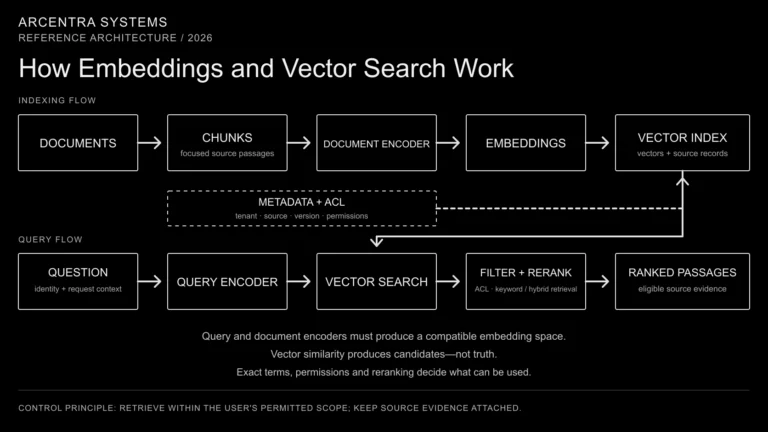
- retrieval pipeline, index and embedding versions;
- tool definitions and output schemas;
- routing, fallback and policy configuration;
- evaluation dataset and release-gate results.
New bundles should enter production through limited traffic, shadow evaluation or a controlled user cohort. Teams can compare quality, latency, error rate, fallback frequency and cost against the current release before increasing exposure.
Google Cloud’s guidance on AI and ML operational excellence recommends controlled releases, canary strategies, continuous evaluation and rollback triggered by quality or operational signals. The important architectural principle is vendor-independent: rollback must restore a tested behavioural state, not merely point the application at an older model.
Resilience Must Restore the Workflow, Not Only the API
Multi-model routing is often presented as an availability mechanism. It is useful only when the alternative path preserves the requirements of the business operation.
Models differ in context limits, structured-output reliability, tool support, safety behaviour, regional availability and cost. Automatically switching providers may return a response while breaking a schema, losing grounding or bypassing an approved processing boundary.
A production routing policy should choose among four outcomes:
- Retry when the operation is safe to repeat and the failure is likely transient.
- Route when an approved alternative has passed the same workflow tests.
- Degrade when a restricted mode can provide value without performing the risky action.
- Stop when correctness, authorization or business state cannot be established.
Fallback paths need their own evaluation cases, load tests, cost limits and incident drills. They should not be discovered during a provider outage.
The Dapr Agents operational model reflects this broader requirement for agent systems: durable execution, cryptographic identity, tracing, retries, circuit breakers and timeouts sit alongside model access. These runtime mechanisms do not guarantee a correct business outcome, but they provide the infrastructure needed to recover and explain execution.
Production AI Operations Goes Beyond MLOps
MLOps remains important for training, evaluating, registering and deploying models. Many enterprise AI applications, however, consume externally managed models that the organization does not train and cannot directly control.
Their production behaviour can change because of provider capacity, model revisions, prompts, retrieval content, tools, policy or orchestration. The operating boundary is therefore the AI-enabled service, not the model artifact.
Production AI operations connects several disciplines:
- SRE and service management for ownership, SLOs and incident response;
- software delivery for versioning, release gates and rollback;
- AI evaluation for quality, safety and behavioural regression;
- security for identity, data handling and tool authorization;
- FinOps for cost attribution and capacity controls;
- business operations for workflow outcomes and acceptable degradation.
This is also why the capability belongs in the shared enterprise AI infrastructure platform. Every application should not invent its own tracing format, release identity, fallback policy and incident evidence.
The Midnight Test for Operational Readiness
A final readiness review should be run as an operational exercise, not as a slide presentation. Give the on-call team a realistic failure without the original developers in the room.
The service is ready when Operations can demonstrate that it has:
- a named owner for the complete business service;
- dashboards across service, behaviour and business signals;
- alerts tied to an actionable response;
- end-to-end request and workflow traces;
- a searchable history of behaviour-bundle releases;
- a tested rollback and safe-stop procedure;
- documented retry, fallback and reconciliation rules;
- access-controlled diagnostic data with retention policy;
- dependency maps and escalation contacts;
- incident playbooks that include business-state verification;
- a process for turning incidents into regression tests.
The NIST AI Risk Management Framework Core reinforces this lifecycle view. Its Manage function calls for post-deployment monitoring, incident response, recovery, change management, third-party risk monitoring and documented continual improvement.
The test is not whether a team has written these controls down. It is whether the operating team can use them under pressure.
Operability Is the Real Production Boundary
Building AI is an engineering challenge. Operating AI is an organizational capability.
A production system will experience model changes, dependency failures, stale knowledge, unexpected inputs and cost pressure. The durable advantage is not avoiding every incident. It is making incidents bounded, reconstructable and recoverable.
That requires more than model monitoring. It requires a complete operating contract across architecture, release engineering, observability, security, finance and business ownership.
Arcentra Systems’ Operate practice is built around that boundary: services must remain understandable and supportable after the build team leaves the room.
An AI system becomes production-ready when reliability no longer depends on permanent access to the people who created it.
The model may answer in seconds. The real test is whether Operations can support the service at midnight.