For two decades, the center of enterprise architecture was comparatively stable. ERP systems managed resources and transactions. CRM systems organized customer relationships. Integration platforms moved data between applications. Data warehouses consolidated analytics, while API gateways exposed internal services through consistent contracts.
Those systems remain essential. But another shared layer is forming beside them: enterprise AI infrastructure.
This is not simply a larger collection of models. It is the technical and operational boundary through which business applications reach models, enterprise knowledge, tools and agents. As adoption spreads, that boundary starts carrying responsibilities that no individual AI feature can manage well on its own: identity, policy enforcement, routing, evaluation, observability, audit, data controls and cost allocation.
The architectural transition is easy to miss because it begins as a series of local product decisions. A support team adds an assistant. Engineering adopts a coding agent. Operations automates document handling. Risk introduces AI-assisted analysis. Each initiative looks independent until the same dependencies and controls appear in every design review.
At that point, AI has crossed the line from application capability to enterprise platform.
What Is Enterprise AI Infrastructure?
Enterprise AI infrastructure is the shared technical foundation that enables business applications to use AI models, governed enterprise knowledge and agents securely and reliably. It combines model access, retrieval, orchestration and agent execution with reusable controls for identity, authorization, safety, evaluation, observability, audit and cost.
An enterprise AI platform is the operating form of that infrastructure. It gives application teams stable contracts for using AI without requiring each team to rebuild provider integrations, knowledge connectors, policy checks and telemetry pipelines. The platform can span public cloud, private infrastructure and on-premises systems; its defining property is not where it runs, but which responsibilities it standardizes.
That distinction matters. A model can generate an answer. A platform must determine whether the request is allowed, which model and data boundary are appropriate, what tools may be invoked, how quality will be measured and how the entire execution can be reconstructed later.
AI Starts as a Feature and Becomes a Shared Dependency
Most organizations do not decide to build an enterprise AI platform on day one. They begin with a queue of narrow requests:
- add a customer-service assistant;
- improve enterprise search;
- summarize documents;
- support software development;
- automate a back-office workflow;
- introduce an agent that can act across internal systems.
The first implementation usually optimizes for speed. The application calls one model provider directly. Prompts live in the application repository. Retrieval is built for one corpus. Model names, token limits and fallback behavior become application configuration. Logging captures HTTP success or failure, but not the reasoning path, retrieved evidence, tool activity or output quality.
That design is rational for a prototype. It becomes expensive when repeated.
The second and third teams need the same mechanisms: provider credentials, model selection, prompt versions, content filtering, permission-aware retrieval, tool registration, human approval, evaluation datasets, tracing and usage reporting. Independently implemented, these mechanisms drift. Identical risks receive different controls. Provider changes require edits across many applications. Audit evidence is collected in incompatible formats.
A technology becomes a platform when multiple products depend on common services and operating rules. Enterprise AI infrastructure meets that test as soon as repeated controls become more important than any single model integration.
This transition is also visible in industry standards. OpenTelemetry semantic conventions establish common meanings for telemetry across traces, metrics, logs and events; the GenAI conventions cover concepts such as model operations, token usage, evaluation and tool calls. Standards of this kind become valuable when operations must work consistently across libraries, providers and applications—not just inside one demo.
The Model Is a Dependency, Not the Platform
The model is the most visible part of an AI system because it produces the visible output. Architecturally, however, it is one dependency inside a larger execution path.
For any enterprise request, the surrounding system must answer a sequence of questions:
- Who is making the request, and on whose behalf?
- Which data is that identity permitted to retrieve?
- Which model is acceptable for the task, risk level, latency target and data location?
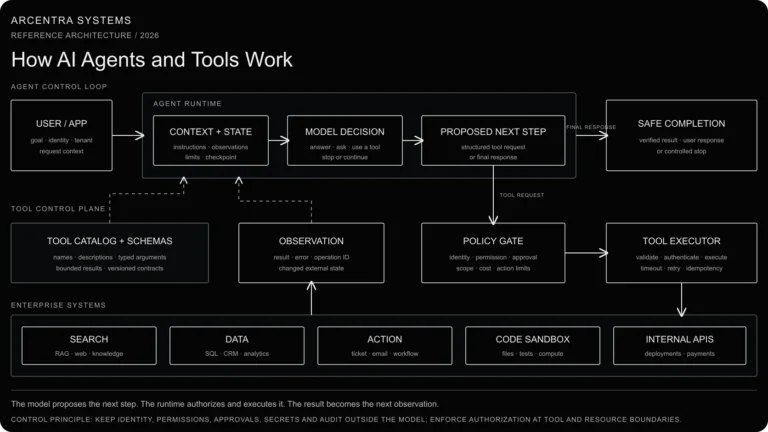
- Which tools may an agent discover and execute?
- What output checks or human approvals are required?
- What evidence must be retained for operations, audit and improvement?
These are platform questions because the answers should remain coherent across a portfolio of applications. If every team embeds them in prompts and application code, policy becomes distributed, implicit and difficult to verify.
AWS makes a similar separation in its enterprise agentic AI reference architecture: applications consume shared capabilities for model access, tools and knowledge bases, while security, observability and discoverability span the architecture. The specific implementation is vendor-dependent; the architectural principle is not. Models, knowledge and tools are separate resources that require a shared control boundary.
A Reference Architecture for an Enterprise AI Platform
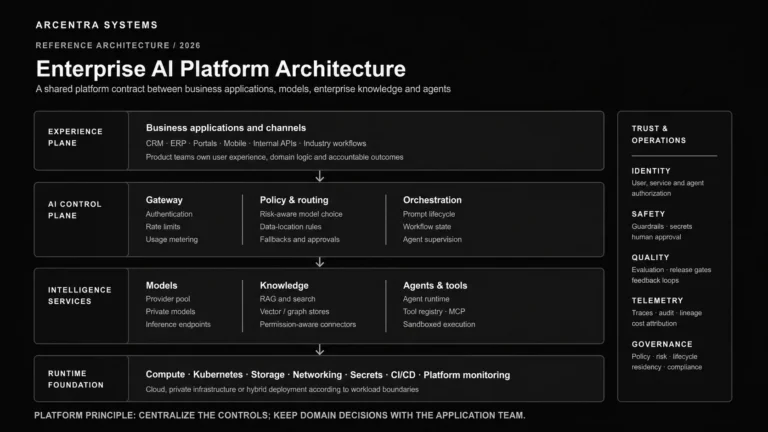
Arcentra Systems models the platform as four planes inside one trust and operations envelope. This is deliberately different from a simple vertical “app → model → database” diagram. In production, models, knowledge and agents are peer capabilities coordinated by a control plane; enterprise systems remain the sources of authority and action.
1. Experience plane
The experience plane contains the business applications and channels where AI creates value: CRM and ERP extensions, portals, mobile applications, internal APIs and industry workflows.
Product teams should continue to own the user experience, domain rules and accountable outcomes. A central platform team cannot decide whether a credit-review workflow is correct, what a service agent should escalate or which evidence a regulated decision requires. Those are domain decisions.
The platform supplies the common contract below them.
2. AI control plane
The AI control plane is the governed entry point for AI execution. It normally includes three groups of capabilities:
- Gateway services authenticate callers, protect provider credentials, enforce quotas and record usage.
- Policy and routing select models and deployment boundaries according to task, risk, data location, latency and cost. They also define fallbacks and approval gates.
- Orchestration manages prompt versions, workflow state, multi-step execution and supervised agent behavior.
This layer is more than a reverse proxy. An HTTP gateway can distribute traffic; an AI control plane must understand enough execution context to apply AI-specific policy. A summarization request over public material and an agent request to update a financial system may use the same model family, yet require entirely different authorization, evidence and oversight.
3. Intelligence services
The platform exposes three peer capability groups:
- Models: external providers, private models and specialized inference endpoints.
- Knowledge: retrieval, enterprise search, vector or graph stores, and connectors that preserve source permissions.
- Agents and tools: agent runtimes, tool registries, MCP servers, workflow engines and isolated execution environments.
Keeping these capabilities separate prevents a common design error: treating retrieval as a hidden part of the model call or treating tool permission as a prompt instruction. Knowledge access must inherit enterprise authorization. Tool execution must be enforced by identity and policy. Model choice should remain replaceable without rewriting either mechanism.
4. Runtime foundation
The runtime foundation provides compute, Kubernetes or another scheduler, storage, networking, secrets, delivery pipelines and platform monitoring. It may be delivered in public cloud, private cloud, on-premises infrastructure or a hybrid topology.
Deployment location should follow workload boundaries. Sensitive knowledge may remain inside a controlled environment while selected requests use an external model through a governed route. High-volume inference may run on dedicated infrastructure while experimental workloads use managed APIs. The platform contract should allow those decisions to change without forcing business applications to absorb the underlying topology.
The trust and operations envelope
Identity, safety, quality, telemetry and governance cross every plane. They cannot be added as a final box at the bottom of a diagram.
The NIST AI Risk Management Framework is intentionally lifecycle-oriented, and its Generative AI Profile extends the framework with actions for risks specific to generative systems. The architectural implication is straightforward: governance needs evidence from design, deployment and operation. Runtime controls without evaluation are incomplete; evaluation without traceable production behavior is equally incomplete.
Standalone AI Application vs. Enterprise AI Platform
A packaged AI application can be useful and production-ready. The distinction is not “bad product versus good platform.” It is the scope of responsibility.
| Concern | Standalone application | Enterprise platform |
|---|---|---|
| Model access | Direct provider integration | Governed gateway with policy-based routing |
| Knowledge | Local RAG pipeline and connectors | Shared, permission-aware knowledge services |
| Identity & tools | App-managed credentials and tool calls | Enterprise identity, registered tools and scoped execution |
| Evaluation | Ad hoc tests and release checks | Shared datasets, scorecards and release gates |
| Operations | Application logs and provider dashboards | End-to-end traces, audit evidence and usage attribution |
| Governance | Controls embedded in each product | Portfolio-wide policy with accountable ownership |
The standalone approach remains appropriate for a contained use case with limited integration and risk. The platform approach becomes necessary when several applications need the same controls, when AI can act on enterprise systems, or when audit and operating consistency matter across business units.
What a Mature AI Platform Changes
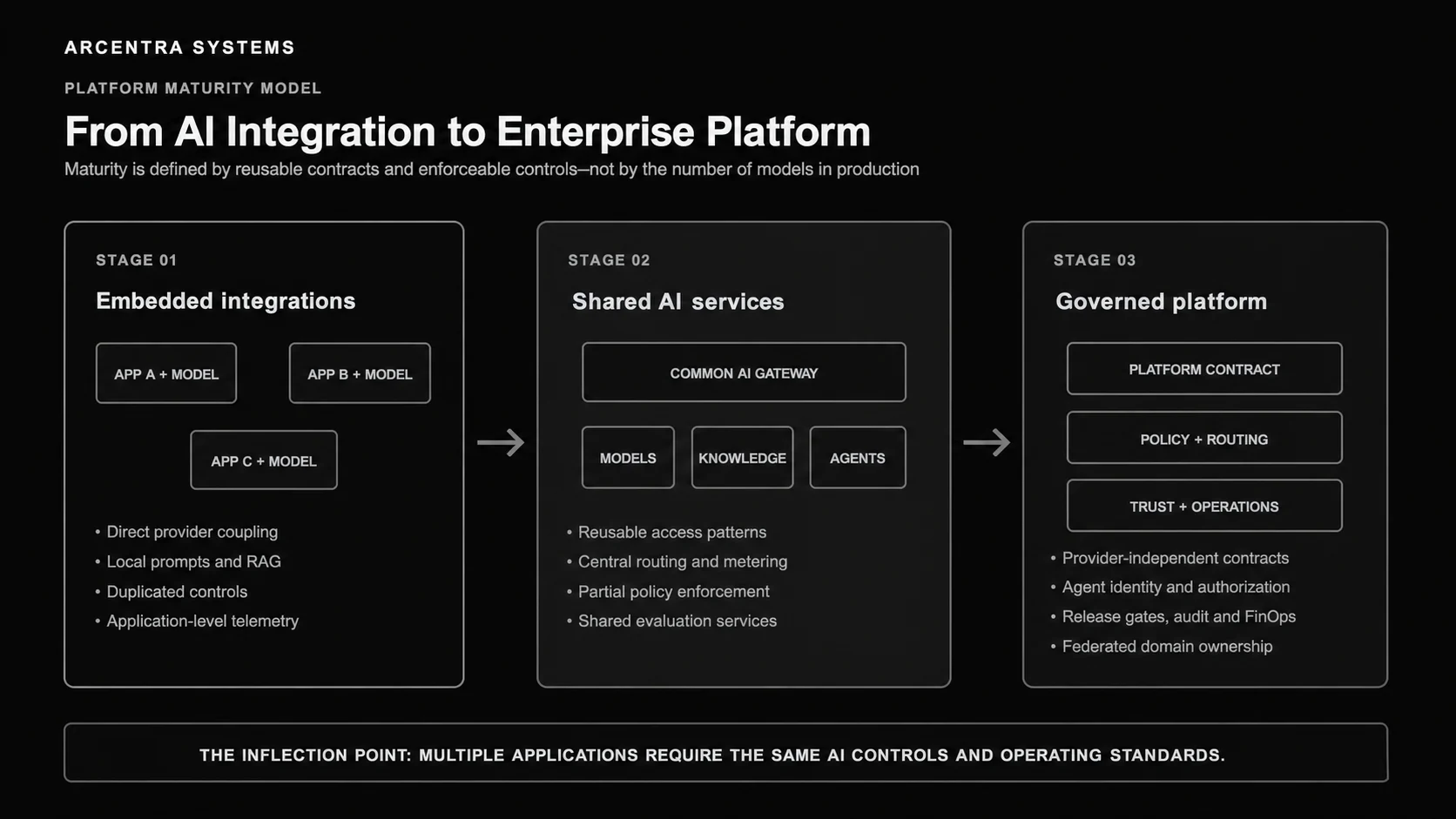
Maturity is not measured by the number of models deployed. It is measured by the quality of the contracts between applications and shared AI capabilities.
Model selection becomes policy
Early applications hard-code a provider because that is the fastest route to a working feature. A mature platform treats model selection as a policy decision. The route can consider task type, sensitivity, residency, latency, quality history, capacity and unit cost.
This does not require routing every request among many models. It requires keeping the decision outside business code so that the organization can change it deliberately.
Knowledge access preserves source authorization
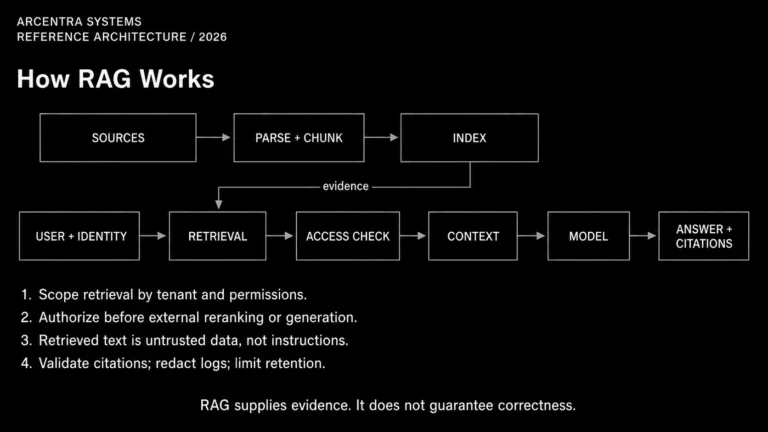
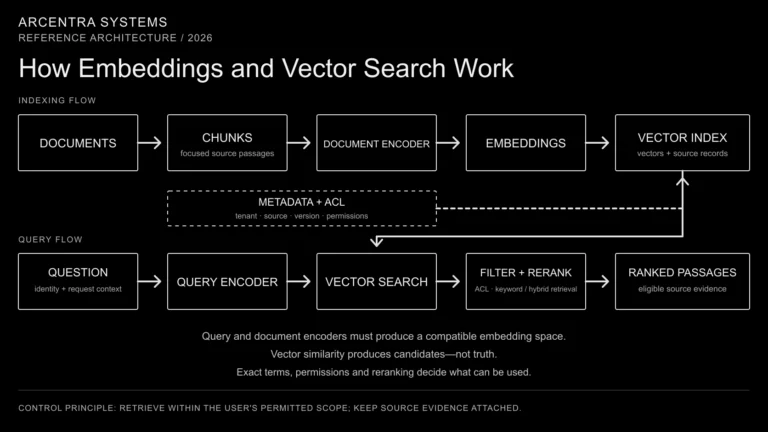
Retrieval quality is not enough. If a user cannot read a source document in its system of record, an AI answer must not expose that document indirectly. The knowledge layer therefore needs permission-aware ingestion, query-time filtering, provenance and lifecycle rules—not only embeddings and a vector database.
This is one reason enterprise RAG belongs in shared infrastructure. The reusable asset is not merely a retrieval library; it is the security and evidence model around retrieval.
Agents receive identities and bounded authority
Agents introduce a different risk boundary because they can take action. A tool description tells a model what a function does; it does not grant legitimate authority to execute it.
The World Economic Forum’s 2026 playbook for trusted AI agents proposes an Agent Capability and Authorization Profile that joins delegation policy, system design and operational oversight. The useful architectural idea is that an agent’s authority should be explicit, enforceable and auditable across its lifecycle.
In practice, the platform should know which agent is acting, which user or service delegated the task, what resources and operations are allowed, when approval is mandatory and how authority expires. Arcentra Systems applies the same distributed-systems discipline in our work on moving agent ecosystems from prototype to production.
Evaluation becomes part of delivery
Traditional tests verify deterministic behavior around the model. AI evaluation measures the probabilistic behavior that those tests cannot capture: groundedness, task success, safety, retrieval relevance, tool selection and policy compliance.
A mature platform provides common evaluation interfaces and datasets while allowing domain teams to define what “good” means for their workflow. Results become release evidence. A new model, prompt, retrieval configuration or tool definition should pass an appropriate evaluation gate before receiving production traffic.
Observability connects quality to execution
Infrastructure metrics remain necessary, but CPU, latency and error rate cannot tell an operator whether an answer used the wrong source or an agent chose an unsafe tool sequence. AI telemetry needs to connect model calls, retrieval events, tool invocations, policy decisions, evaluation scores and cost to the originating business transaction.
That is why observability belongs in the platform contract rather than in a vendor dashboard. The organization needs one execution narrative across application, gateway, model, knowledge and tools. Our broader approach to production AI infrastructure starts with that operational requirement.
The Platform Team Should Centralize Controls, Not Business Logic
Platform initiatives often fail by centralizing too much. A team that owns every prompt, agent and knowledge source becomes a delivery bottleneck and quietly assumes responsibility for domains it does not understand.
A better operating model is federated:
- The AI platform team owns gateways, provider integration, runtime services, common policy enforcement, evaluation tooling, telemetry and paved-road delivery patterns.
- Security, risk and data governance define control requirements and review evidence.
- Domain product teams own workflows, user experience, business rules, domain evaluations and outcomes.
- Operations teams own service objectives, incident response and capacity with shared telemetry from the platform.
The boundary can be expressed as a simple principle: centralize the controls that must be consistent; keep decisions that require domain accountability with the application team.
This is platform engineering, not the construction of one universal AI application. Arcentra Systems’ Design, Build and Operate model follows the same lifecycle: architecture, implementation and long-term operation are different responsibilities, but they must share one technical contract.
When Should an Enterprise Build the Shared Layer?
Not every organization needs a full platform immediately. Premature abstraction can be as wasteful as duplicated infrastructure. The strongest signals are operational:
- Multiple applications integrate with the same models or knowledge sources.
- Teams are rebuilding identity, retrieval, guardrails or evaluation independently.
- Provider changes require coordinated edits across product codebases.
- Agents need access to business systems with different permission boundaries.
- Risk, audit or finance teams cannot reconstruct usage and decisions consistently.
- Production incidents cross the boundary between application, model, data and tool execution.
Once several of these conditions are present, the question is no longer whether a shared layer exists. An accidental one already exists in duplicated libraries, informal standards and operational workarounds. The architectural choice is whether to make it explicit.
The transition should be incremental:
- Establish one governed model-access path with identity, secrets and usage metering.
- Standardize telemetry and a minimal evaluation contract.
- Add reusable knowledge access with permission and provenance controls.
- Introduce agent and tool authorization before scaling autonomous execution.
- Separate platform interfaces from specific providers and deployment locations.
Each step should remove duplicated risk or operational work. A platform justified only by future elegance will struggle for adoption; a platform that shortens delivery while improving control becomes a product teams choose to use.
The Future Question Is Architectural
Within a few years, asking whether an enterprise “uses AI” will carry little architectural meaning. Almost every software portfolio will contain models, assistants and automated decisions.
The differentiating questions will be more demanding:
- How does the platform decide which models and data boundaries are acceptable?
- Can applications move between providers without rewriting business logic?
- Does knowledge access preserve enterprise permissions and provenance?
- How are agents identified, authorized and stopped?
- Can operators connect quality, risk, latency and cost to a business workflow?
- What evidence supports a production release or an audit?
Enterprises are unlikely to operate dozens of independent AI stacks indefinitely. They will converge on shared contracts for model access, knowledge, agents and control—just as they standardized identity, integration, delivery and observability for earlier generations of enterprise systems.
AI is not becoming another feature of the enterprise.
AI infrastructure is becoming part of the enterprise architecture itself.
For Arcentra Systems, that defines the work: we engineer the platform on which enterprise AI can operate, scale and survive change.