Enterprise AI projects are often framed as model-selection exercises. Teams compare reasoning quality, context windows, latency and price, then assume implementation begins once a provider has been chosen.
In practice, a capable model is usually the easiest component to replace.
The difficult work begins when an AI system must operate inside the enterprise: use live data, preserve existing permissions, resolve inconsistent identifiers, call business APIs, survive partial failures and leave evidence that operators and auditors can reconstruct.
A model can be connected through an API in minutes. Connecting that model to a bank, fintech platform, retailer or industrial operator can take months because the integration must carry more than data. It must carry identity, authority, workflow state and evidence across systems that were not designed to participate in probabilistic execution.
That is the real enterprise AI integration problem.
What Is Enterprise AI Integration?
Enterprise AI integration is the engineering discipline that connects models and agents to corporate identities, data, applications, events and transaction systems through controlled, observable workflows.
It includes connectors and APIs, but it is not defined by their number. A production integration must preserve four properties across every boundary:
- Identity: who initiated the request, which service or agent is acting and on whose behalf.
- Authority: which records, tools and operations are permitted in the current context.
- State: what has already happened, which version of a record is current and whether a workflow is complete.
- Evidence: which sources, decisions, calls and outcomes must be retained for operations, audit and improvement.
If any one of these properties disappears between the AI application and a system of record, the workflow becomes unreliable even when the model response appears correct.
This is why enterprise AI integration requires architecture rather than a growing collection of point-to-point connectors. The model speaks in tokens. The enterprise operates through identities, records, transactions, events and approval rules. The integration layer is where those two environments are reconciled.
The Model Call Is One Step in a Distributed Transaction
An enterprise AI request should be treated as an execution path, not as a prompt followed by an answer.
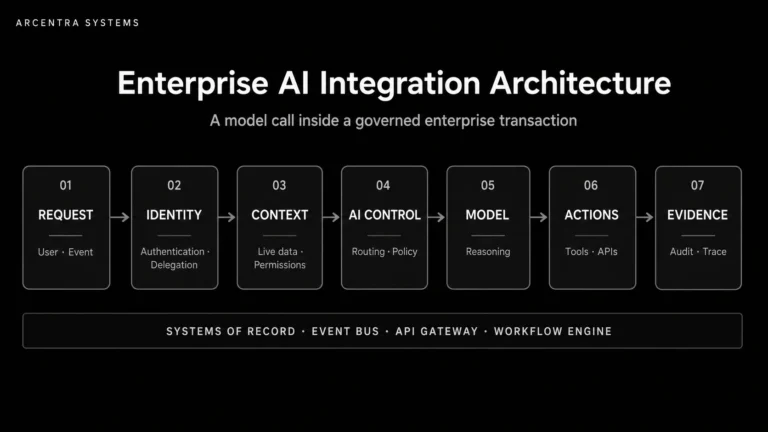
A user request or business event first establishes an identity. The system then determines delegated authority, retrieves current context, applies policy, chooses a model, invokes tools or APIs and records evidence about the outcome. The model call sits near the middle of this path. It does not own the path.
The surrounding integration may involve an identity provider, SSO, Active Directory or LDAP; CRM, ERP or core banking systems; SharePoint, Confluence or document repositories; relational databases; message brokers and event buses; secrets management; an API gateway; a workflow engine; and security monitoring.
The complexity does not come from connecting twenty endpoints. It comes from preserving meaning across them.
A customer number in a CRM may not match the identifier in a core banking platform or fraud system. A document may remain searchable after the policy it describes has expired. An employee may be permitted to view a customer record but not the investigation associated with it. A downstream system may accept an update but time out before acknowledging it.
These are not language-model problems. They are distributed-systems and enterprise-integration problems.
A Banking AI Request Is Not a Question-Answering Flow
Consider a request such as: “Show me the latest suspicious transactions for customer John Smith.”
The visible task looks like information retrieval. The actual banking AI integration may need to:
- Authenticate the employee and establish the active session.
- Determine whether the employee is allowed to access suspicious-activity information.
- Resolve which John Smith is intended without leaking records for other customers.
- Map the customer across CRM, core banking and fraud-monitoring identifiers.
- Retrieve current transactions and their investigation status.
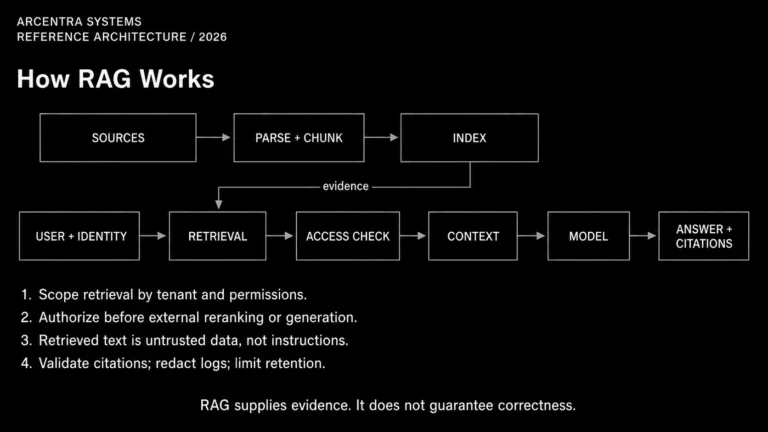
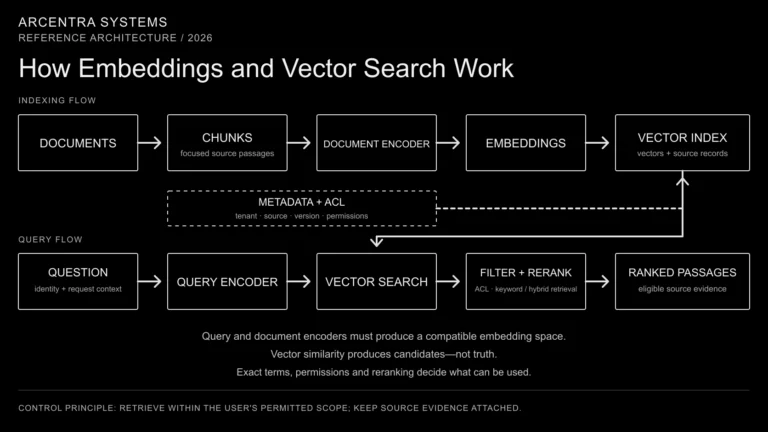
- Search relevant policies and case documents with source-level permissions.
- Assemble evidence for the model without crossing disclosure boundaries.
- Generate the response and apply output policy.
- Record the sources, decisions and downstream calls in an audit trace.
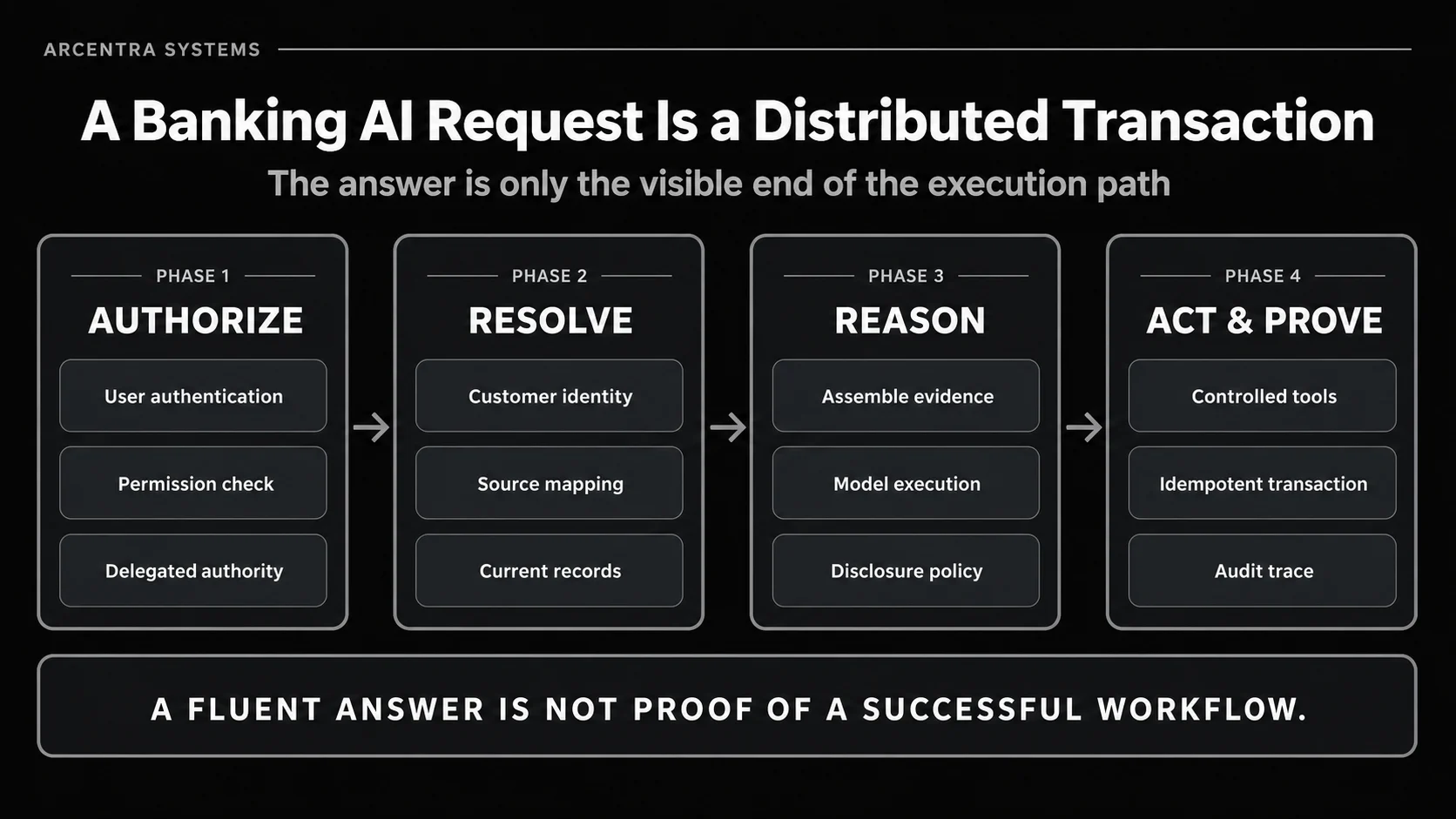
The model may complete its part in seconds. The surrounding system must establish which customer the user means, whether the request is authorized, which records are current, what each fraud flag means and which evidence may be disclosed.
In February 2026, the Central Bank of the Republic of Uzbekistan announced that solutions selected through its AI Challenge were moving into banking-system implementation. The program includes an Uzbek-language speech-to-text model and a retrieval-based assistant for regulatory and institutional information. The Central Bank states that the solutions will run on internal servers to protect confidential information and banking secrecy.
The significant engineering transition is not only the development of models for Uzbek language and banking terminology. It is their integration into controlled institutional workflows, source systems and operational boundaries.
Authentication Is Not End-to-End Authorization
Logging a user into an AI application does not automatically authorize every retrieval or action performed on that user’s behalf.
Many demonstrations use one privileged service account for all downstream calls. This reduces implementation time, but it removes the relationship between the employee’s authority and the data returned by the model. Every request effectively receives the permissions of the integration account.
Production systems need separate identities for the user, agent and downstream service. Authority must be delegated explicitly and narrowed for the task. The integration chain should be able to answer:
- Which human or service initiated the task?
- Which agent is executing it?
- Which permissions were delegated?
- Which tool and parameters were authorized?
- When does that authority expire?
- Which system enforced the decision?
The NIST National Cybersecurity Center of Excellence addresses these questions in its 2026 concept paper on software and AI agent identity and authorization. It treats delegation, least privilege, auditing and the binding of agent actions to human authority as separate requirements—not as consequences of successful login.
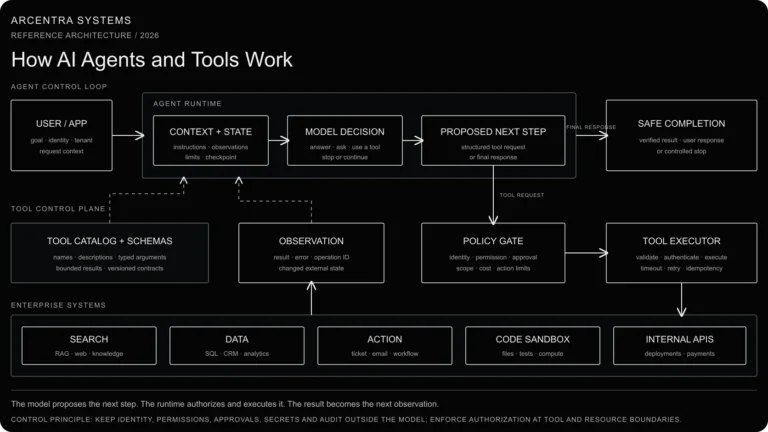
An agent allowed to read a transaction should not automatically inherit the authority to freeze an account, export a complete customer history or open a fraud investigation. Tool descriptions tell a model what an operation does. They do not grant legitimate permission to execute it.
Agents Turn Integration Flows Into Transactions
Integration becomes more demanding when the AI system moves from reading information to changing enterprise records.
An agent may select tools dynamically, revise its plan or repeat a call after an ambiguous response. In a transactional environment, an uncontrolled retry can create a duplicate payment, reopen a resolved case, reserve inventory twice or send the same customer notification repeatedly.
An agentic integration therefore needs mechanisms familiar from distributed transaction processing:
- idempotency keys for operations that may be retried;
- explicit state transitions rather than inferred progress;
- timeouts and circuit breakers around unreliable dependencies;
- compensating actions when a multi-system workflow fails partway through;
- approval gates for high-impact or irreversible operations;
- durable records of tool inputs, outputs and business outcomes.
Model reasoning cannot replace these controls. A convincing explanation of an action does not make the action authorized, atomic or reversible.
The AWS enterprise architecture for agentic AI separates access to models, tools and knowledge sources for this reason. Tool discovery and secure execution are distinct platform capabilities, with authorization applied to the actor and execution context.
Google Cloud’s reference architecture for orchestrating access to disparate enterprise systems follows the same principle. MCP servers form an anti-corruption layer between the agent and backend systems, while IAM, structured logging and distributed tracing remain separate operational requirements.
MCP can standardize how a tool is described and invoked. It does not remove the need for authorization, transaction semantics or failure handling behind that tool.
A Fluent Answer Can Hide an Integration Failure
Traditional enterprise applications usually expose failure. A missing record produces an error. A rejected transaction returns a status. A timed-out dependency prevents the screen from completing.
AI systems create a more dangerous possibility: part of the workflow can fail while the final answer remains fluent.
A response may combine current transaction data with an obsolete policy document. A search connector may return only part of an authorized corpus. One action may succeed while a second system times out. The model can still produce a coherent narrative because fluency is not evidence that every dependency completed correctly.
This changes the definition of AI integration testing. Evaluating answer quality is necessary, but insufficient. Tests must also cover:
- revoked permissions during an active session;
- ambiguous users, customers or account identifiers;
- stale, contradictory or partially indexed sources;
- unavailable tools and degraded downstream APIs;
- duplicated requests and delayed acknowledgements;
- partially completed multi-system actions;
- policy changes between retrieval and execution;
- audit records that cannot be correlated end to end.
The central test is not whether the model answers under ideal conditions. It is whether the integrated system behaves safely when its dependencies provide incomplete, delayed or contradictory evidence.
AI Integration Monitoring Must Follow the Business Transaction
Monitoring only the model call cannot explain why an integrated AI workflow failed.
Teams need a trace connecting the initiating identity, authorization decisions, retrieved sources, model requests, tool selection, downstream API calls, retries and final business outcome. Without that chain, operators cannot distinguish a model problem from a stale index, slow permission service, retry loop or unavailable system of record.
The OpenTelemetry guidance for generative AI observability standardizes telemetry for model operations, token usage, tool calls and tool results. That provides an important part of the execution narrative. Enterprise AI integration must extend the same trace into identity services, retrieval infrastructure, workflow engines and business APIs.
A successful model response is not a successful transaction if the required downstream action did not occur.
End-to-end tracing also changes cost management. The cost of an AI workflow includes retrieval, data movement, tool execution, retries, external services and operational capacity—not only model tokens. Usage must be attributed to the application and business workflow that created it.
This is one reason observability is a core capability in the enterprise AI infrastructure platform, rather than an optional dashboard attached to a model provider.
Enterprises Need a Shared AI Integration Layer
Large organizations cannot sustainably build a separate integration mechanism for every assistant and agent.
A shared AI integration layer should provide stable contracts for:
- identity propagation and delegated authority;
- access to models, knowledge and approved tools;
- API orchestration and event handling;
- retries, idempotency and common failure policies;
- workflow state and approval gates;
- end-to-end telemetry and audit evidence;
- usage attribution and operational controls.
This layer does not eliminate integration work. It moves repeated controls into shared engineering components while leaving business meaning with the teams that understand each domain.
The platform team may own the gateway, tool registry, orchestration runtime and telemetry contract. A banking team must still define what constitutes a suspicious transaction, which investigation states are valid and when human approval is mandatory. A retailer must still own inventory, pricing and fulfilment semantics.
Centralize the mechanics that must be consistent. Federate the decisions that require domain accountability.
Arcentra Systems applies this boundary across Design, Build and Operate: architecture, implementation and long-term operation are distinct responsibilities, but they must share one integration contract.
When Should the Shared Layer Be Built?
Not every prototype requires a platform. A direct model call can be appropriate when the use case is isolated, read-only and low-risk.
The shared layer becomes justified when several of the following conditions appear:
- Multiple AI applications connect to the same systems of record.
- Teams independently rebuild identity propagation, retrieval or tool authorization.
- Agents can create, update or delete enterprise records.
- Workflows span systems with different transaction and failure semantics.
- Operators cannot reconstruct a request across the model and downstream services.
- Audit, security or finance teams cannot attribute actions and cost consistently.
- Provider or system changes require coordinated edits across many applications.
At that point, the organization already has an AI integration layer—it is simply distributed across application code, duplicated connectors, privileged service accounts and operational workarounds.
The architectural task is to make it explicit.
Better Models Do Not Remove the Integration Problem
As models improve, the model’s share of the total engineering problem often becomes smaller.
Models can be replaced without changing the business objective. Enterprise identifiers, permission structures, transaction rules, source semantics and operational dependencies remain specific to the organization. A stronger model may reduce reasoning errors, but it cannot determine which customer record is authoritative, repair a broken delegation chain or make a non-idempotent banking API safe to retry.
Companies do not struggle with enterprise AI only because models are insufficient. They struggle because useful AI must operate inside systems that already encode decades of business meaning and control.
The future of enterprise AI will not be decided by better models alone.
It will be decided by integration architecture designed to preserve identity, authority, state and evidence across the complete transaction path.
The model generates the answer. Engineering determines whether the answer can be trusted—and whether the enterprise survives acting on it.