AI infrastructure is usually described with the language of technology: GPU generations, cluster size, interconnect, tokens per second and model performance.
Its economics are governed by a different vocabulary: capital cost, asset life, contract tenor, utilization, counterparty concentration, collateral value and refinancing.
A software startup can add users before it has perfected monetization because distribution is comparatively cheap and product capacity can often expand incrementally. An AI infrastructure provider must secure power, facilities, networking and accelerators before customers consume the resulting capacity. Cash leaves first. Revenue follows later, and only if the assets are delivered, remain competitive and stay sufficiently utilized.
That structure does not make an infrastructure company a bank. It does mean that growth is increasingly determined by bank-like disciplines: underwriting future cash flow, matching assets and liabilities, protecting liquidity and controlling concentration.
The most important strategic question is therefore not only how much compute a provider can build.
It is whether the provider can finance, contract and renew that compute without allowing growth to weaken the balance sheet.
What Is AI Infrastructure Financing?
AI infrastructure financing is the capital structure used to fund the power, data centers, servers, accelerators and networks that deliver AI compute before those assets generate stable cash flow.
It can include retained earnings, equity, corporate bonds, bank facilities, equipment leases, private credit, project-finance vehicles and asset-backed securities. Different instruments allocate construction, utilization, technology and refinancing risk differently, but they all address the same timing problem: productive capacity must exist before it can be sold.
This timing problem is expanding beyond the balance sheets of the largest technology companies. The Bank for International Settlements reports that hyperscalers are increasingly supplementing internal cash flow with long-term bonds and off-balance-sheet vehicles backed by private credit. The debt of those vehicles is serviced by leases and long-term capacity commitments.
The result is a financial supply chain around the technical supply chain. Capital providers fund facilities and equipment; infrastructure operators convert them into available compute; customer contracts convert capacity into cash flow; and that cash flow services the capital raised at the beginning.
Every stage must remain aligned.
Startup Growth and Infrastructure Growth Use Capital Differently
Venture capital usually buys a software startup time and optionality. It funds product development, hiring and distribution while the company searches for repeatable demand. If a software release underperforms, the company can change the product without necessarily carrying a corresponding portfolio of long-dated physical obligations.
AI infrastructure capital buys productive capacity. It is converted into sites, grid connections, transformers, cooling, network fabric and chips. Those commitments cannot be rewritten as quickly as software.
The distinction produces different growth constraints:
- a software startup asks whether customer acquisition and retention can scale;
- an infrastructure provider asks whether funded capacity can be placed under durable, profitable demand;
- a startup treats unused cash as runway;
- an infrastructure provider can hold unused compute that still incurs financing, power-reservation and operating costs;
- a startup can slow hiring when demand weakens;
- an infrastructure provider may still owe debt service and lease payments on assets already commissioned.
Revenue growth remains important in both models. In infrastructure, however, growth must be read together with the balance sheet. Expanding capacity can increase revenue while simultaneously increasing leverage, counterparty exposure and the volume of assets that must be refinanced or replaced.
That is why conventional startup metrics provide an incomplete picture.
The AI Infrastructure Balance Sheet
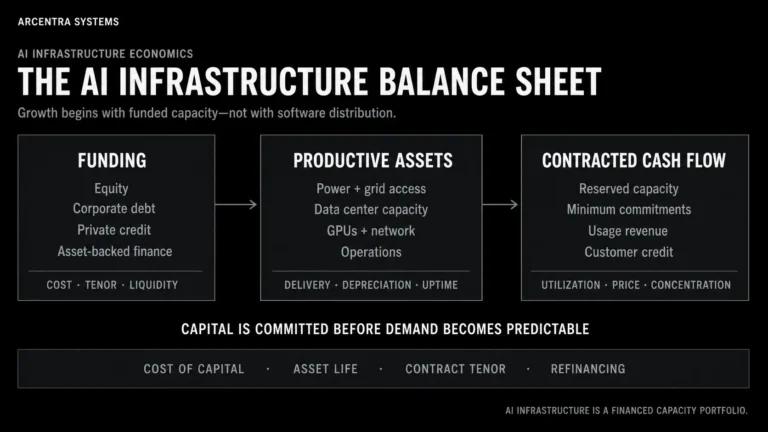
An AI infrastructure provider can be understood as a financed capacity portfolio.
On the left side is funding: equity, corporate debt, private credit or asset-backed finance. In the middle is the productive asset base: power access, buildings, electrical and cooling systems, GPUs, networking and operations. On the right are the contracts and usage that produce cash flow.
The provider creates value when the income generated by the capacity exceeds the cost of financing, operating and renewing it over the relevant period.
This sounds straightforward, but each layer runs on a different clock:
- Power and construction clock: sites, generation, substations and grid connections can require years of planning and delivery.
- Contract clock: customer commitments may begin before commissioning, step up over time or contain renewal and exit rights.
- Technology clock: the economic competitiveness of accelerators and network architecture can change faster than the physical facility.
- Financing clock: interest, principal, lease payments and refinancing dates follow a fixed schedule regardless of utilization.
The architecture is financially resilient only when these clocks are compatible.
The International Energy Agency identifies grid connections, transformers, turbines, advanced chips and approvals as active constraints on data-center expansion. Power availability is therefore not merely an engineering dependency. It determines when funded assets can begin producing revenue and how long capital remains tied up before operation.
Customer Contracts Are Also Underwriting Instruments
In a software business, a contract mainly demonstrates demand and creates recurring revenue. In capital-intensive AI infrastructure, a long-term contract can also support the financing of specific capacity.
Lenders and investors therefore care about more than total contract value. They examine:
- the customer’s credit quality;
- contract duration and renewal mechanics;
- minimum usage or take-or-pay commitments;
- pricing and escalation clauses;
- termination rights and performance conditions;
- the relationship between contracted demand and financed capacity;
- concentration in the largest customers.
This is underwriting in an economically meaningful sense. The provider is deciding whether future demand from a counterparty is strong enough to support an asset that must be financed today.
The parallel with banking is structural. A lender does not evaluate a loan book only by its headline interest income. It considers maturity, repayment capacity, collateral and concentration. An infrastructure operator should not evaluate its sales pipeline only by projected revenue. It also needs to understand how each commitment supports debt service and how the portfolio behaves if one buyer reduces demand.
A contract can reduce uncertainty while creating a new risk. Long duration improves revenue visibility, but dependence on a small number of large customers concentrates cash flow. Minimum commitments protect utilization, but broad termination or performance clauses may return the risk to the provider. A creditworthy customer can strengthen financing, but a contract is only as reliable as its enforceability and the capacity actually delivered.
Sales, treasury, engineering and operations are therefore evaluating different sides of the same transaction.
The Core Risk Is a Four-Way Maturity Mismatch
AI infrastructure combines long-lived commitments with assets whose economic performance may change quickly.
The building, power connection and cooling system may operate for decades. Debt or leases may extend for many years. Customer contracts may be shorter or contain optionality. Accelerators can remain functional while becoming less attractive because a newer generation delivers more performance per watt or per dollar.
This creates four potential mismatches:
- asset versus debt: the asset may lose economic value faster than the liability is repaid;
- contract versus debt: committed customer revenue may end before the financing matures;
- power versus deployment: reserved electricity and site capacity may begin costing money before compute is installed and accepted;
- technology versus demand: hardware may remain operational while customer workloads migrate toward more efficient alternatives.
Depreciation is therefore not only an accounting policy. It is an operating and financing assumption about how long the asset can produce competitive cash flow.
If the assumed economic life is too long, reported margins can look stronger while the renewal requirement is understated. If it is too short, the business may appear less profitable even when older hardware continues serving suitable workloads. The correct answer depends on workload mix, pricing, energy efficiency, software optimization and secondary-market demand.
The important discipline is to model the asset fleet by economic role rather than assume that every accelerator follows the same life cycle.
Utilization Is a Financing Variable
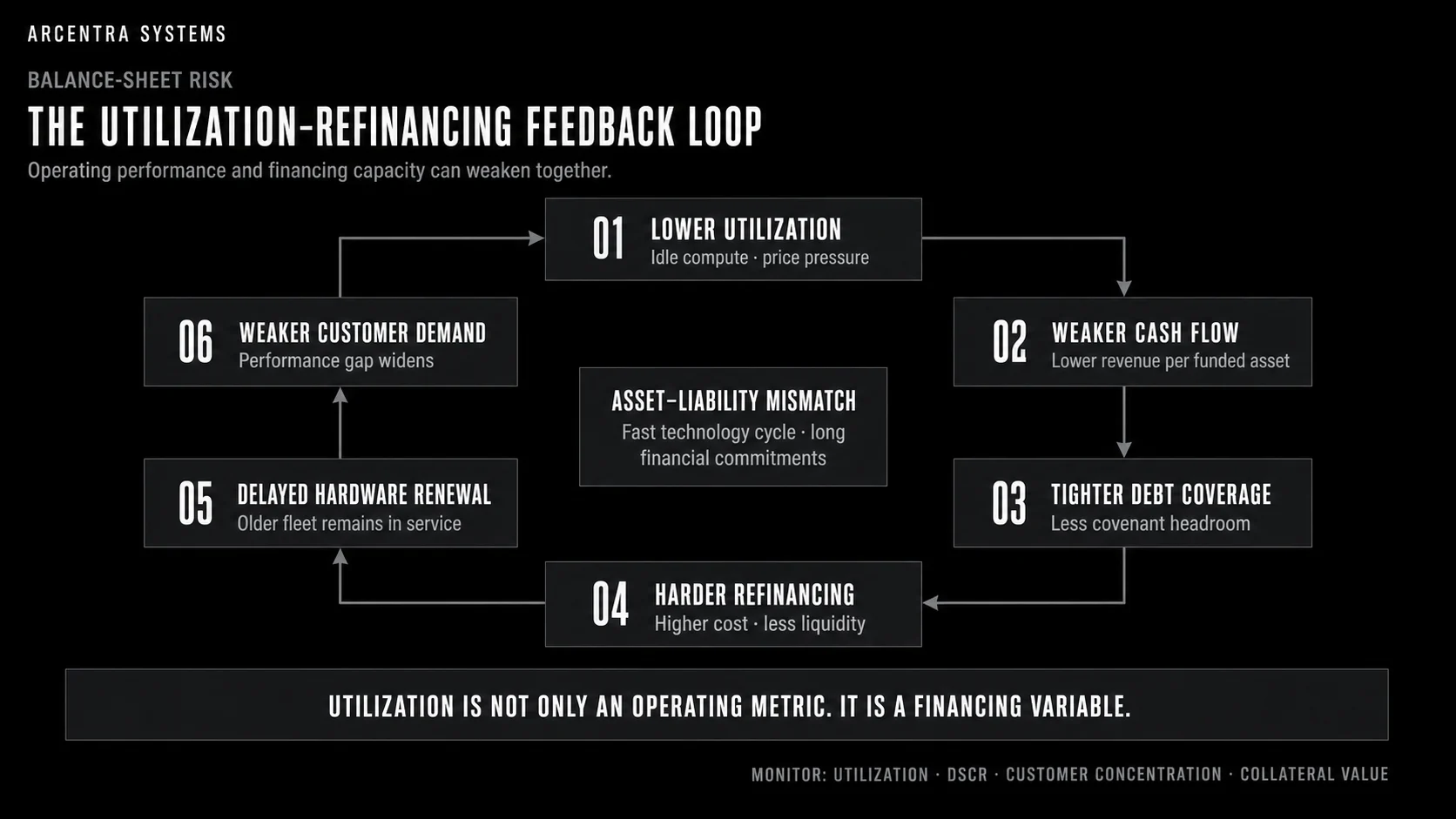
Utilization is normally treated as an operating metric. In a leveraged infrastructure business, it also determines financing capacity.
When utilization falls, revenue per funded asset declines while many costs remain fixed. Cash flow weakens, debt-service coverage narrows and covenant headroom can disappear. Refinancing becomes more expensive or less available. If the provider then delays hardware renewal, the fleet can become less competitive, placing further pressure on demand and utilization.
The loop works in the opposite direction as well. Strong contracted utilization improves cash-flow visibility. Better visibility can reduce financing cost, support fleet renewal and allow the provider to offer more competitive capacity. Operational performance and access to capital reinforce each other.
This is why a provider can report growing customers and revenue while still moving toward financial stress. The questions are whether growth produces adequate return on the funded asset base and whether cash flow arrives before financial obligations become due.
Useful operating metrics therefore include:
- utilization by cluster, hardware generation and customer;
- revenue and gross margin per available accelerator-hour;
- power and facility cost per delivered unit of compute;
- debt-service coverage and interest coverage;
- contracted versus merchant or on-demand utilization;
- renewal capex required to maintain competitive performance;
- customer concentration and contract expiry profile;
- collateral value and refinancing schedule.
The dashboard for an AI infrastructure platform is partly an operations dashboard and partly a treasury dashboard.
Off-Balance-Sheet Financing Does Not Remove Operating Risk
Special-purpose vehicles and joint ventures can separate individual projects, attract different pools of capital and match financing more closely to contracted assets. They can also convert upfront capital expenditure into long-term lease or capacity payments.
Those structures may move accounting exposure, but they do not automatically remove economic dependency.
The BIS describes arrangements in which dedicated vehicles own or develop data-center assets, raise private debt and rely on long-term leases, capacity offtake agreements or guarantees from hyperscalers. It characterizes some of these obligations as economically similar to borrowing even when much of the debt sits outside the sponsor’s main balance sheet.
The practical questions remain:
- who absorbs construction delays and cost overruns;
- who guarantees minimum payments;
- what happens when capacity is unavailable or obsolete;
- whether assets have alternative customers;
- which party must refinance the vehicle;
- whether guarantees or termination payments bring risk back to the sponsor.
The IMF Global Financial Stability Report also points to growing data-center financing through private bilateral credit, corporate debt, asset-backed securities and commercial mortgage-backed securities. Securitization broadens access to capital, but it also distributes exposure across lenders and investors that may depend on the same underlying customers and technology cycle.
Financial structure can redistribute risk. It cannot eliminate the physical and commercial performance on which repayment ultimately depends.
Why the Banking Analogy Is Useful—and Where It Stops
AI infrastructure companies are not banks. They do not accept deposits, create money or hold diversified loan books governed by banking capital rules. GPUs are productive equipment, not loans, and customer contracts are not borrower repayments in a legal sense.
The comparison is useful because both models require capital before income, manage assets and obligations with different durations, depend on liquidity and can be damaged by concentration or loss of confidence.
The correct lesson is not that infrastructure providers should be valued as banks. It is that they need comparable balance-sheet discipline.
That discipline includes:
- underwriting the durability and credit quality of contracted demand;
- matching financing maturity to realistic asset cash flow;
- reserving liquidity for construction delays and utilization shocks;
- limiting exposure to individual customers, sites and hardware generations;
- stress-testing prices, power costs, refinancing rates and residual values;
- separating accounting depreciation from economic obsolescence;
- monitoring guarantees and obligations outside the primary balance sheet.
The Federal Reserve Bank of Dallas notes that AI data-center financing needs are likely to be both large and persistent, with long-term corporate bonds and private-credit structures adding duration to fixed-income markets. This makes cost and availability of capital part of infrastructure competitiveness, not merely a finance-department concern.
A Better Scorecard for AI Infrastructure Economics
Revenue growth, booked capacity and market share describe demand. They do not show whether the infrastructure portfolio can sustain itself.
A more complete scorecard should connect five groups of measures:
- Demand: contracted capacity, backlog quality, renewal probability and customer concentration.
- Assets: commissioned capacity, delivery schedule, utilization, energy efficiency and fleet age.
- Unit economics: revenue, contribution margin and cash return per funded unit of capacity.
- Capital: weighted cost of capital, leverage, debt-service coverage, liquidity and maturity schedule.
- Renewal: economic asset life, residual value, refresh capex and ability to migrate workloads across generations.
No single metric is sufficient. High utilization can be unprofitable if pricing is too low. Strong contracted revenue can be fragile if one customer dominates. Low leverage can still hide large lease or purchase commitments. Rapid growth can destroy value if every new generation requires capital faster than the previous fleet repays it.
The scorecard should be evaluated under stress, not only under the base forecast. What happens if commissioning is six months late, power costs rise, a customer does not renew, new hardware compresses market pricing or refinancing costs increase?
These scenarios reveal whether the business owns a resilient infrastructure portfolio or a sequence of optimistic funding assumptions.
Infrastructure Finance Is Also a Customer Risk
The balance sheet of an AI infrastructure provider matters to more than its investors and lenders.
Enterprises increasingly place important workloads on specialized AI clouds, model providers and managed platforms. Their procurement process often evaluates model quality, security, sovereignty, performance and price. It should also consider whether the provider can continue financing the capacity and operational controls on which the service depends.
A financially constrained provider may defer hardware renewal, reduce redundancy, renegotiate capacity, change pricing or depend more heavily on a small number of upstream partners. Technical availability can therefore be influenced by refinancing and capital-allocation decisions that customers never see directly.
For material workloads, due diligence should examine:
- the provider’s dependence on one facility, funding source or hardware supplier;
- the amount of capacity supported by durable customer commitments;
- the renewal and refinancing profile of critical assets;
- contractual protections if capacity is delayed or withdrawn;
- portability and exit mechanisms for the customer’s workloads;
- evidence that the service can be operated through financial as well as technical stress.
This extends the resilience model described in Arcentra Systems’ work on enterprise AI infrastructure platforms and production AI operations. Architecture, operations and finance meet at the same point: the ability to keep delivering a governed service under changing conditions.
AI Infrastructure Is Becoming a Capital Business
AI infrastructure may be designed by technology companies, but its expansion increasingly depends on infrastructure finance.
Capital must be committed before demand becomes predictable. Contracts must support assets that will operate for years. Hardware must generate sufficient cash before its economic position declines. Power, utilization and refinancing must remain aligned across multiple investment cycles.
That changes what good infrastructure strategy looks like.
The winning provider will not necessarily be the one that announces the most GPUs or raises the most capital. It will be the one that converts capital into reliable capacity, capacity into durable cash flow and cash flow into timely renewal—without allowing concentration, maturity mismatch or idle assets to destabilize the system.
Arcentra Systems approaches this as a combined architecture and operating problem through Design, AI infrastructure implementation and long-term service operation.
AI infrastructure is built like technology, financed like infrastructure and managed through disciplines that increasingly resemble banking.